
Speech Confidence: Transforming Client Presentations

Standing in front of clients with sweaty palms and a racing mind is a familiar scene for many marketing professionals across Canada and the United States. The truth is, effective public speaking goes beyond memorising a script or projecting your voice. Speech confidence is a skill built through practice and preparation, not an inborn gift. This guide clears up common misconceptions and explains how you can develop genuine confidence that lasts, helping you command the room and connect with your audience at every pitch or presentation.
Table of Contents
- Defining Speech Confidence And Common Misconceptions
- Types Of Speech Confidence In Professional Settings
- Essential Traits Of Confident Speaking
- Body Language, Vocal Delivery, And Preparation
- Typical Challenges And How To Overcome Them
- Maximising Speech Confidence With AI Feedback
Key Takeaways
| Point | Details |
|---|---|
| Understanding Speech Confidence | Speech confidence is a skill built through practice, emotional control, and effective communication techniques rather than an innate trait. |
| Types of Confidence | Professionals should recognise three types of confidence: situational, performance-based, and trait confidence, each valuable in enhancing communication efficacy. |
| Importance of Non-verbal Communication | Body language, vocal delivery, and thorough preparation significantly impact how confidence is perceived by audiences. |
| Overcoming Anxiety | Addressing public speaking anxiety requires a comprehensive approach, combining psychological preparation and practical skills to manage presentation challenges effectively. |
Defining Speech Confidence and Common Misconceptions
Speech confidence represents an individual’s psychological state of self-assurance while communicating, extending far beyond mere verbal articulation. It encompasses a complex interplay of mental preparation, emotional regulation, and communication skills that enable professionals to express themselves authentically and persuasively. Professional communication research suggests that self-confidence directly influences communication effectiveness across academic, personal, and professional domains.
Contrary to popular belief, speech confidence is not an innate trait but a skill that can be systematically developed and refined. Many professionals mistakenly assume that confident speakers are naturally gifted or extroverted. However, research demonstrates that confidence can be cultivated through targeted practice, self-awareness, and strategic communication techniques. The misconception that only naturally charismatic individuals can become compelling speakers undermines the potential for personal growth and communication excellence.
Specifically within professional settings, speech confidence involves multiple interconnected dimensions. These include vocal clarity, body language, emotional control, content mastery, and the ability to adapt communication style to different audiences. Linguistic studies on accented speech reveal that listener perceptions can be significantly influenced by unconscious biases, highlighting the importance of recognising and transcending stereotypical assumptions about communication competence.
Pro tip: Practice recording your presentations and analyse your delivery objectively, focusing on identifying specific areas for improvement rather than overall performance.
Types of Speech Confidence in Professional Settings
Professional speech confidence is a multifaceted construct that manifests in various nuanced forms across different workplace scenarios. Research on public speaking anxiety reveals distinct categories of confidence that professionals must understand and develop, including situational, trait, and performance-based confidence. These types represent unique psychological and communicative approaches that professionals can strategically cultivate to enhance their overall communication effectiveness.
Situational confidence refers to an individual’s ability to adapt their communication style and emotional regulation based on specific professional contexts. For instance, a marketing professional might demonstrate high confidence during client presentations but experience moderate anxiety during unexpected Q&A sessions. Performance confidence centres on an individual’s perception of their ability to execute communication tasks successfully, which is heavily influenced by past experiences, skill levels, and personal self-assessment.
Nonverbal communication research highlights that vocal and visual markers significantly contribute to perceived confidence in professional settings. These markers include body language, vocal tone, eye contact, and gestural precision. Professionals who understand and intentionally manage these nonverbal elements can substantially improve their perceived confidence, regardless of their internal emotional state. Trait confidence, the most stable form, represents an individual’s inherent self-belief and consistent communication approach across various professional interactions.
Pro tip: Systematically record and analyse your professional presentations to objectively track your confidence progression and identify specific areas for targeted improvement.
Here is a comparison of the main types of speech confidence in professional settings:
| Type of Confidence | Key Features | Typical Scenario | Development Strategy |
|---|---|---|---|
| Situational | Adapts to context, fluctuates | Client presentation | Practice in varied environments |
| Performance-based | Reflects task-specific belief | Pitching a campaign | Track and review progress |
| Trait | Stable self-assurance, consistent | Networking events | Build habits and self-reflection |
Essential Traits of Confident Speaking
Confident speaking is a sophisticated skill comprising multiple interconnected psychological and physical attributes. Key traits of public speaking reveal that effective communication extends far beyond mere verbal articulation, encompassing emotional intelligence, physical presence, and strategic preparation. Professionals who master these essential traits can transform ordinary presentations into compelling narrative experiences that captivate and influence their audiences.
The foundational traits of confident speaking include vocal clarity, deliberate body language, and cognitive preparedness. Vocal characteristics such as consistent volume, measured pace, and articulate pronunciation signal competence and command of the subject matter. Body language plays an equally critical role, with confident speakers demonstrating open postures, purposeful gestures, and steady eye contact that communicate authenticity and trustworthiness. Psychological research on communication skills emphasises that these physical manifestations are deeply intertwined with an individual’s internal psychological state.
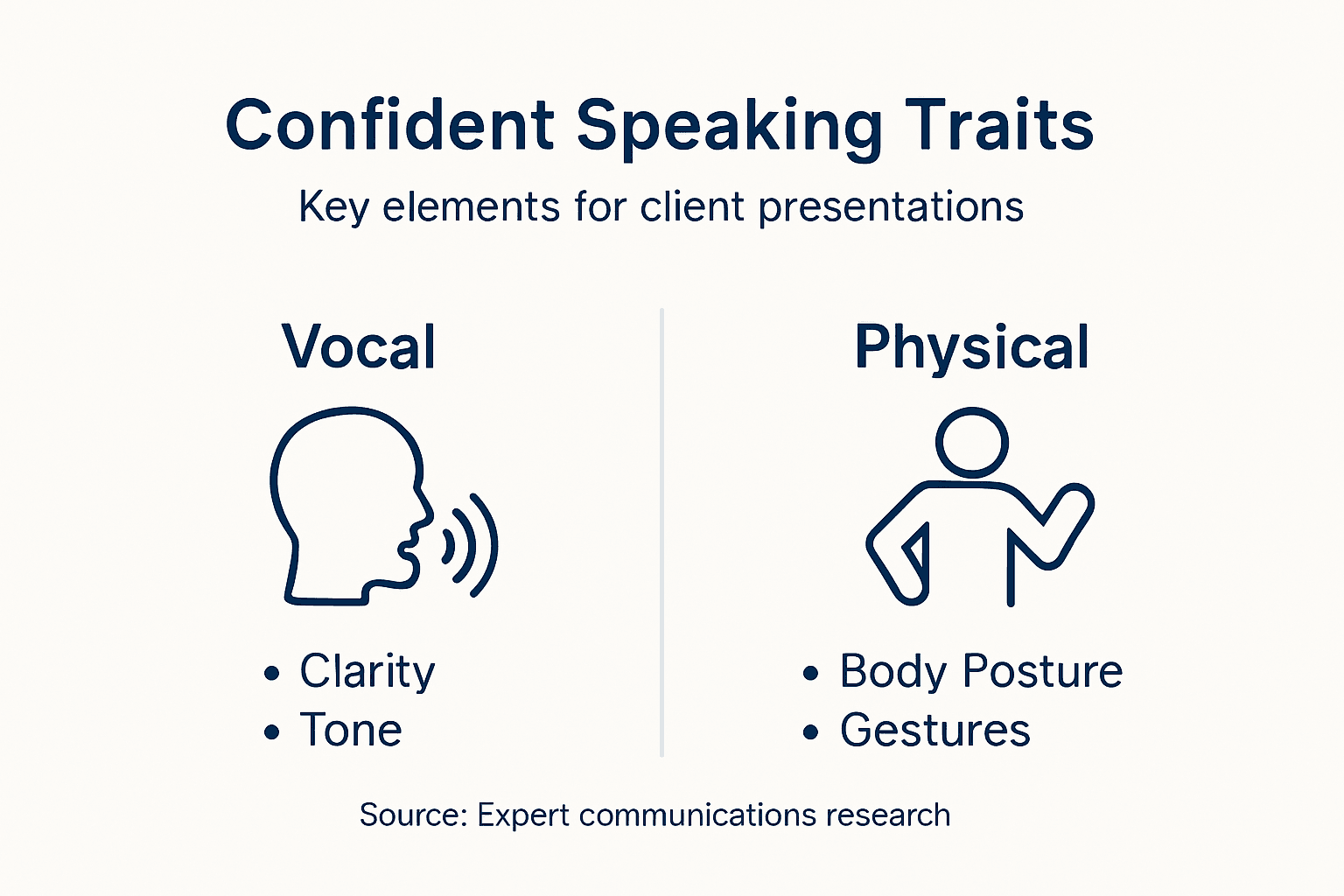
Cognitive readiness represents another crucial trait of confident speaking. This involves thorough content preparation, anticipating potential questions, and maintaining emotional equilibrium under pressure. Confident speakers demonstrate the ability to adapt their communication style dynamically, responding to audience engagement with flexibility and grace. They understand that confidence is not about eliminating nervousness entirely, but managing and channelling emotional energy effectively to enhance their communicative impact.
Pro tip: Practice your presentation in environments that simulate actual speaking conditions, including potential distractions, to build genuine adaptive confidence.
Body Language, Vocal Delivery, and Preparation
Effective client presentations require a sophisticated integration of physical, vocal, and cognitive elements that collectively communicate professional confidence. Research on speech disfluencies reveals that body language, vocal delivery, and meticulous preparation are interconnected factors that significantly influence audience perception and speaker credibility. Successful professionals understand that confidence is not merely an internal state but a carefully choreographed external performance.

Body language serves as a powerful non-verbal communication tool that can either reinforce or undermine verbal messaging. Confident speakers maintain an open posture, with squared shoulders, controlled gestures, and direct eye contact that signal authenticity and command. Vocal delivery complements physical presence through strategic modulation of pitch, pace, and volume. Variations in vocal tone can emphasise critical points, maintain audience engagement, and convey emotional nuance without appearing rehearsed or artificial. Systematic vocal analysis techniques demonstrate how precise control of vocal parameters can dramatically enhance communication effectiveness.
Preparation remains the foundational element that underpins both body language and vocal delivery. Thorough content mastery allows speakers to navigate unexpected questions, manage potential interruptions, and maintain composure under pressure. This involves not just memorising content, but developing a deep understanding that enables flexible, adaptive communication. Professionals who invest time in comprehensive preparation can transform potential anxiety into confident, dynamic presentation experiences that resonate with their audience.
Pro tip: Record yourself presenting and analyse your body language, vocal patterns, and content flow to identify subtle areas for improvement that might not be immediately apparent during live delivery.
Here’s a summary of the critical elements that impact perceived confidence during client presentations:
| Element | What It Influences | Example in Practice |
|---|---|---|
| Body Language | Credibility, authenticity | Open posture, direct eye contact |
| Vocal Delivery | Engagement, clarity | Varied pitch and steady pace |
| Preparation | Composure under pressure | Handling unexpected questions |
Typical Challenges and How to Overcome Them
Public speaking anxiety represents a profound challenge that undermines professional communication effectiveness for many marketing professionals. Comprehensive research on speaking challenges reveals that anxiety stems from complex psychological factors including fear of judgment, imposter syndrome, and performance expectations. These internal barriers can significantly diminish a professional’s ability to communicate confidently and persuasively during critical client presentations.
Professionals frequently encounter specific obstacles that compromise their speech confidence. These include managing unexpected questions, controlling physiological stress responses like trembling hands or voice quavering, and navigating cultural communication differences. Best practices for managing speech anxiety suggest systematic desensitization techniques, which involve gradually exposing oneself to speaking scenarios, developing robust mental preparation strategies, and implementing targeted cognitive behavioural interventions to reframe negative thought patterns.
Overcoming these challenges requires a multifaceted approach that combines psychological preparation, practical skill development, and consistent practice. Successful professionals learn to transform anxiety into energy, viewing presentations as opportunities for connection rather than potential sources of embarrassment. This involves developing robust mental frameworks, understanding personal triggers, and creating personalised coping mechanisms that allow for authentic, compelling communication. Strategies such as thorough content preparation, mindfulness techniques, and structured rehearsal can help professionals build resilience and gradually reduce speech-related anxieties.
Pro tip: Create a pre-presentation ritual that helps you centre your thoughts and regulate your emotional state, such as deep breathing exercises or positive visualisation techniques.
Maximising Speech Confidence with AI Feedback
Advanced artificial intelligence represents a transformative approach to developing speech confidence, offering professionals unprecedented opportunities for objective self-improvement. AI-driven feedback systems provide nuanced, personalised analysis of vocal delivery, enabling speakers to identify and address subtle communication challenges with remarkable precision. These technologies go beyond traditional coaching methods by offering real-time, data-driven insights into speech characteristics that directly impact presentation effectiveness.
The mechanics of AI feedback involve sophisticated machine learning algorithms that analyse multiple speech parameters simultaneously. These include vocal pitch variation, speech rhythm, articulation clarity, pause duration, and emotional tone. Psychological research on public speaking demonstrates that such comprehensive analysis can help professionals deconstruct their communication patterns, revealing unconscious habits that might undermine their perceived confidence. By providing granular, objective feedback, AI tools create a structured pathway for continuous communication skill enhancement.
Successful implementation of AI feedback requires a strategic, reflective approach. Professionals should view these technological insights as constructive guidance rather than criticism, using the data to incrementally refine their speaking style. This might involve addressing specific vocal filler words, modulating speaking pace, or improving gestural synchronisation with verbal content. The ultimate goal is developing a more authentic, compelling communication style that resonates with diverse professional audiences, transforming potential communication barriers into opportunities for personal and professional growth.
Pro tip: Commit to reviewing your AI-generated speech feedback consistently, focusing on implementing one targeted improvement per presentation to ensure sustainable skill development.
Elevate Your Speech Confidence with AI-Powered Insights
Struggling with public speaking anxiety or unsure how to refine your vocal delivery and body language for client presentations? This article highlights critical challenges like managing unexpected questions, mastering emotional control, and improving nonverbal markers to communicate with authenticity and authority. Whether you face situational or performance-based confidence issues, the key to growth lies in objective feedback and consistent practice.
Discover how Pavone.ai turns these challenges into opportunities. Our platform uses advanced AI to analyse your speech, vocal tone, pace, use of filler words, and even gestures, giving you precise, actionable insights. Track your progress over time and transform nervous energy into compelling connection. Start building your confident speaking skills today with Pavone.ai here and see how easy it is to take control of your communication journey. Get started now to unlock your full potential and create powerful client interactions.
Frequently Asked Questions
What is speech confidence and why is it important?
Speech confidence refers to an individual’s self-assurance while communicating, encompassing mental preparation, emotional regulation, and communication skills. It’s crucial for effective communication in professional settings, impacting how messages are received and understood.
How can I develop my speech confidence?
Speech confidence can be developed through targeted practice, self-awareness, and strategic communication techniques. Regular rehearsal, seeking feedback, and understanding your audience can enhance confidence over time.
What are the types of speech confidence in professional settings?
There are three main types of speech confidence: situational confidence, which adapts based on context; performance-based confidence, which reflects one’s belief in their task execution; and trait confidence, which is a stable self-belief across interactions. Understanding these can help professionals focus on areas for growth.
What role does body language play in speech confidence?
Body language significantly influences perceived confidence. Open postures, purposeful gestures, and steady eye contact can enhance the delivery of a message, creating an impression of authenticity and trustworthiness. Effective body language supports vocal delivery and preparation efforts.
Recommended
Ready to practice?
Start improving your speaking skills with AI-powered feedback and analysis.
Try Pavone Free