
How to Get a Job: A Step-by-Step Guide for Tech Pros

Facing interview anxiety is common for skilled professionals in demanding technology roles, especially when English is not their first language. In a competitive global job market, your digital identity can make a real difference. By focusing on practical strategies like updating your CV, optimising your LinkedIn profile and practising video interview techniques, you will create greater visibility and improved confidence. This guide offers step-by-step support for refining your professional approach and strengthening your interview performance.
Table of Contents
- Step 1: Update Your CV And LinkedIn Profile
- Step 2: Identify Suitable Job Opportunities
- Step 3: Prepare Tailored Applications
- Step 4: Practise Video Interview Skills With Pavone
- Step 5: Verify And Refine Your Interview Performance
- Step 6: Track Progress And Adjust Your Approach
Quick Summary
| Key Message | Explanation |
|---|---|
| 1. Update Your CV and LinkedIn | Regularly enhance your CV and LinkedIn profile to reflect recent achievements and skills. |
| 2. Research Job Opportunities | Explore diverse channels like government platforms and professional networks for hidden job openings. |
| 3. Tailor Your Job Applications | Personalise each application to align closely with the job description, emphasising relevant skills and achievements. |
| 4. Practise Video Interview Skills | Use platforms like Pavone to rehearse video interviews and improve your professional presence and communication. |
| 5. Track Job Search Progress | Maintain a detailed log of applications, responses, and networking efforts to identify trends and refine your strategy. |
Step 1: Update your CV and LinkedIn profile
Creating a powerful digital professional identity is crucial in today’s competitive job market. This step will help you transform your CV and optimise your LinkedIn profile to showcase your unique professional strengths.
Start by conducting a comprehensive review of your current CV and LinkedIn profile. You’ll want to update these documents strategically, highlighting your most recent achievements and skills. Focus on the following key areas:
- Professional Summary: Craft a compelling narrative about your career trajectory
- Work Experience: Update with recent roles, responsibilities, and quantifiable achievements
- Skills Section: Include industry-specific keywords relevant to your target roles
- Professional Achievements: Highlight specific accomplishments with measurable outcomes
Your LinkedIn profile serves as more than just an online resume - it’s a dynamic representation of your professional brand. A well-maintained profile can significantly increase your visibility to potential employers and recruiters.
Pay special attention to your profile picture, ensuring it looks professional and approachable. Choose a high-quality headshot where you appear confident and well-presented. Your headline should be more than just your job title - it should communicate your professional value proposition.
Recruiters spend an average of 6-7 seconds scanning a profile, so make every word count.
Professional Recommendation: Regularly update your profile with recent projects, certifications, and skills to maintain a dynamic and engaging professional narrative.
Step 2: Identify suitable job opportunities
Navigating the tech job market requires a strategic approach to discovering roles that match your skills and career aspirations. This step will help you explore and pinpoint professional opportunities that align with your unique professional profile.

Begin by conducting comprehensive research using multiple channels. Explore government job platforms that specialise in technology roles, which often provide extensive listings across various sectors. Government websites can reveal hidden opportunities that might not be advertised on conventional job boards.
Your job search strategy should encompass multiple approaches:
- Online Job Platforms: Leverage websites like LinkedIn, Indeed, and specialised tech recruitment sites
- Professional Networks: Activate your professional connections and alumni networks
- Industry-Specific Websites: Check dedicated technology job boards and company career pages
- Recruitment Agencies: Connect with agencies specialising in technology recruitment
Labour market statistics offer valuable insights into potential career paths and emerging technology roles. Understanding projected job growth and median salaries can help you make informed decisions about your professional trajectory.
Successful job hunting is about quality, not just quantity - focus on roles that genuinely match your skills and career goals.
Consider creating job search alerts on multiple platforms to stay informed about new opportunities. Many recruitment websites allow you to set up customised notifications based on your specific skills, experience level, and preferred locations.
Professional Recommendation: Develop a systematic approach to tracking job applications, including a spreadsheet to monitor positions applied for, application dates, and follow-up actions.
Here’s a summary of common job search channels and their unique advantages:
| Job Search Channel | Distinct Advantage | Ideal For |
|---|---|---|
| Online Job Platforms | Access to diverse, up-to-date listings | Quick role discovery |
| Professional Networks | Hidden opportunities through personal contacts | Building targeted relationships |
| Industry-Specific Websites | Specialised roles and sector news | Niche or technical job seekers |
| Recruitment Agencies | Guidance and market insights from experts | Navigating complex applications |
Step 3: Prepare tailored applications
Crafting a compelling job application requires more than just submitting a generic resume. Your goal is to create personalised application materials that demonstrate your unique value and direct alignment with each specific role.
Start by developing targeted application documents that speak directly to the job description. This means carefully analysing each role and customising your resume and cover letter to highlight the most relevant skills and experiences.
Your tailored application strategy should include:
- Keyword Matching: Incorporate specific terms from the job description
- Achievements Emphasis: Quantify your professional accomplishments
- Skills Alignment: Demonstrate how your expertise matches role requirements
- Company Research: Show genuine understanding of the organisation’s goals
When preparing your application, pay close attention to email application protocols. Your email should be concise, professional, and serve as a compelling introduction to your attached documents.
Successful applications are not about sending more, but sending smarter.
Remember that many companies use applicant tracking systems that filter resumes based on specific criteria. This means your application must be both human-readable and optimised for digital screening.
Professional Recommendation: Create a master resume template that you can quickly customise for each application, saving time while maintaining high-quality, targeted submissions.
Step 4: Practise video interview skills with Pavone
Mastering video interviews is crucial in today’s digital recruitment landscape. Your goal is to develop confidence, improve communication skills, and create a polished professional presence that stands out to potential employers.
Video interview preparation involves more than just technical setup - it’s about presenting your most professional self through a digital medium. Practising with a dedicated platform like Pavone allows you to refine your communication skills in a supportive, low-pressure environment.
Your video interview practice strategy should focus on:
- Technical Readiness: Test camera, microphone, and internet connection
- Background Management: Create a clean, professional setting
- Body Language: Practice maintaining eye contact and confident posture
- Communication Clarity: Develop concise, structured responses
- Stress Management: Build confidence through repeated practice
Some key elements to focus on during your practice sessions include understanding interview communication techniques. Pay attention to your speaking pace, clarity of expression, and overall professional demeanour.
Successful video interviews are about creating a connection, not just answering questions.
The Pavone platform provides real-time feedback, helping you identify areas for improvement and track your progress over time. This targeted approach ensures you’re continuously refining your interview skills.
Professional Recommendation: Record multiple practice interviews, review them objectively, and focus on incremental improvements in your communication and presentation style.
Step 5: Verify and refine your interview performance
Improving your interview skills is an ongoing journey of self-assessment and strategic refinement. This step focuses on developing a systematic approach to evaluating and enhancing your interview performance after each interaction.
Interviewing skills require continuous improvement through deliberate reflection and targeted practice. After each interview, dedicate time to conduct a comprehensive performance review that goes beyond surface-level observations.
Your post-interview analysis should encompass several critical dimensions:
- Technical Content: Assess the depth and relevance of your technical responses
- Communication Clarity: Evaluate your articulation and communication structure
- Body Language: Review non-verbal cues and overall presentation
- Problem-Solving Approach: Analyse how you handled complex questions
- Emotional Intelligence: Reflect on your ability to connect professionally
Additionally, post-interview strategies involve more than just internal reflection. Consider gathering external feedback from mentors, recruiters, or trusted professionals who can provide objective insights into your interview performance.
Every interview is an opportunity to learn, not just to secure a position.
Utilise technologies and platforms that offer detailed performance analytics to track your progress systematically. Record your practice sessions, analyse them objectively, and identify specific areas for improvement.
Professional Recommendation: Maintain a detailed interview performance journal, documenting your strengths, weaknesses, and incremental improvements after each interview experience.
Below is an overview comparing key interview performance assessment methods:
| Assessment Method | Type of Feedback | Primary Benefit |
|---|---|---|
| Self-Reflection | Subjective, personal | Immediate insight on strengths |
| Mentor Consultation | Constructive, external | Unbiased skill gap identification |
| Digital Analytics | Data-driven, objective | Tracks measurable improvements |
Step 6: Track progress and adjust your approach
Successfully navigating your job search requires a systematic approach to monitoring and adapting your strategies. This step focuses on developing a robust tracking mechanism that helps you stay organised and responsive to the evolving job market.
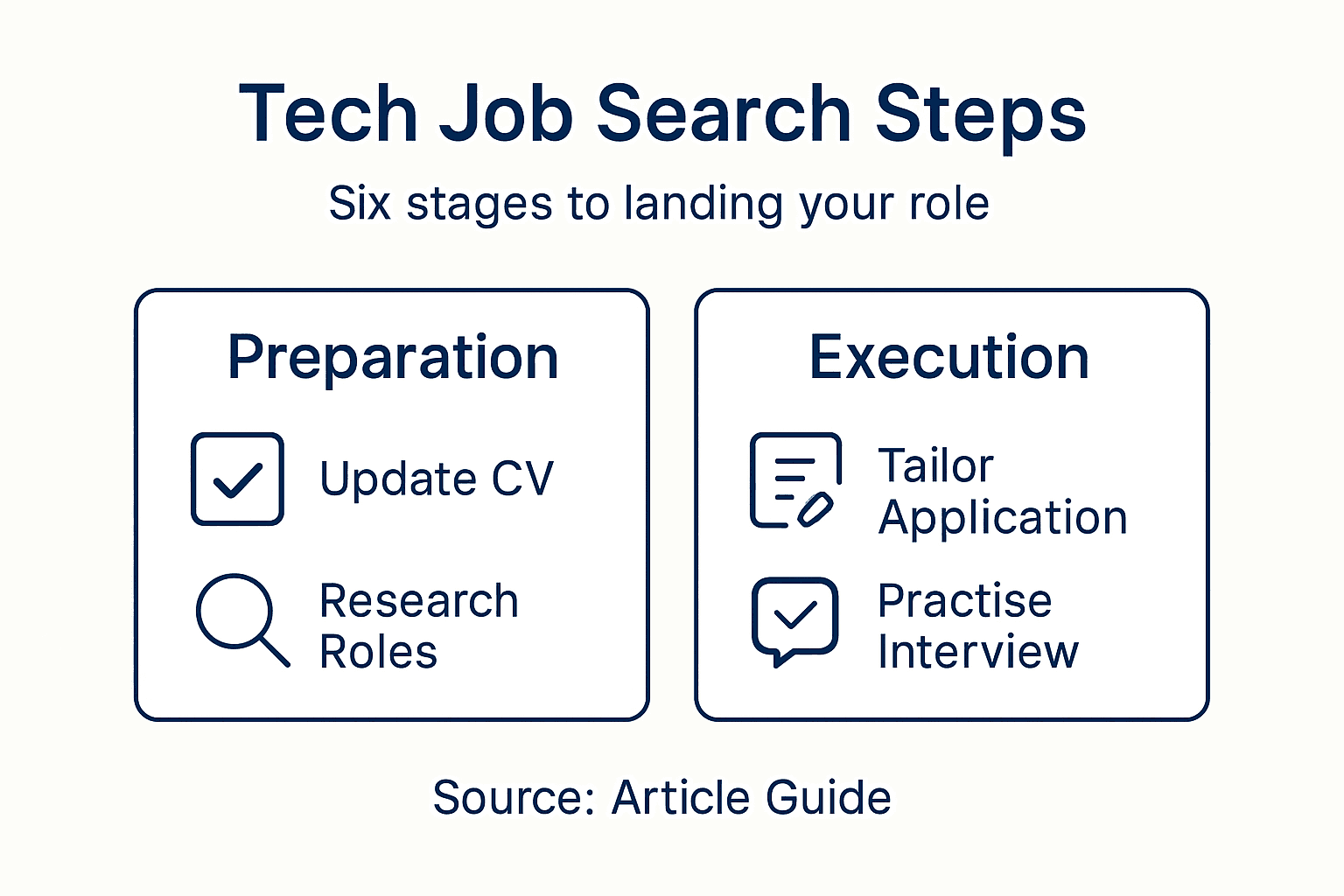
Creating a structured job search plan is fundamental to maintaining momentum and measuring your progress effectively. By implementing a comprehensive tracking system, you’ll transform your job search from a reactive to a proactive process.
Your job search tracking strategy should include:
- Application Log: Document every job application with key details
- Response Tracking: Record interview invitations, rejections, and follow-ups
- Skill Development: Monitor areas requiring additional training or improvement
- Networking Interactions: Log professional connections and potential leads
- Performance Metrics: Analyse response rates and application success
Productive job search organisation involves more than just passive record-keeping. Use digital tools, spreadsheets, or dedicated job search management apps to streamline your tracking process.
Consistent tracking transforms uncertainty into strategic opportunity.
Regularly review and analyse your tracking data to identify patterns, refine your approach, and make data-driven adjustments to your job search strategy.
Professional Recommendation: Set aside dedicated time each week to review your job search metrics and adjust your strategy based on objective insights and performance trends.
Boost Your Interview Confidence with Pavone
The journey from updating your CV to acing the interview can be challenging, especially when it comes to mastering how you communicate your answers on camera. This article highlights the importance of practising video interview skills and refining your interview performance — areas where many tech professionals struggle with confidence, clarity, and structure.
Pavone.ai offers a personalised interview coach to help you tackle these challenges directly. With instant, actionable feedback on your speaking pace, confidence, filler words, and body language, Pavone transforms how you present yourself in video interviews. Practising common interview questions on Pavone allows you to build trust in your own communication style while tracking measurable improvement over time.
Video interview preparation is no longer a guessing game. With Pavone, you can absorb targeted insights on your interview delivery anytime and anywhere, removing the pressure and uncertainty of live interviews. Elevate your interview game, reduce anxiety, and secure your next tech role by practising smarter today at https://pavone.ai.
Mastering video interviews starts with understanding how you come across. Begin your transformation now and become the confident candidate every recruiter wants to meet.
Frequently Asked Questions
How can I update my CV and LinkedIn profile effectively?
To update your CV and LinkedIn profile effectively, focus on your professional summary, work experience, skills, and achievements. Revise these sections to highlight your most recent roles and quantify your accomplishments, ensuring that you use industry-specific keywords.
What steps should I follow to identify suitable job opportunities in tech?
To identify suitable job opportunities in tech, conduct comprehensive research across online job platforms, professional networks, and industry-specific websites. Set up job search alerts to stay informed about new openings that align with your skills.
How do I tailor my job applications for specific roles?
To tailor your job applications, analyse each job description and customise your resume and cover letter accordingly. Incorporate keywords from the job listing, emphasise your relevant achievements, and showcase how your skills align with the role’s requirements.
What should I focus on when preparing for a video interview?
When preparing for a video interview, focus on technical readiness, creating a professional background, and honing your communication skills. Practise maintaining eye contact and clear expression to enhance your overall presentation during the interview.
How can I systematically improve my interview performance?
To improve your interview performance, conduct a comprehensive review after each interview, assessing areas such as technical content, communication clarity, and body language. Use your insights to make specific adjustments and track your progress over time.
What is the best way to track my job search progress?
The best way to track your job search progress is to create a structured application log that includes details like application dates and follow-up actions. Regularly review this log to identify patterns and refine your job search strategies based on your findings.
Recommended
- Body Language in Interviews: Boosting Tech Careers | Pavone Academy
- How to Speak Confidently in Job Interviews - Pavone
- Job Interview Preparations for Confident Video Responses | Pavone Academy
- 7 Best Interview Questions and Answers Examples for Clarity | Pavone Academy
- Get a job teaching English abroad | 3 foundation ‘how’ to tips - EBC Trinity CertTESOL and TEFL courses
- Students Focused on Careers: Aligning Education with Jobs
Ready to practice?
Start improving your speaking skills with AI-powered feedback and analysis.
Try Pavone Free