
7 Best Interview Questions and Answers Examples for Clarity

Facing interview questions can feel overwhelming when you want to present the best version of yourself. Each question is designed to uncover something specific about your skills, mindset, or past experiences, making it tough to know exactly what to say on the spot. The right approach can not only help you answer clearly but also showcase your real strengths.
This guide will give you practical techniques for crafting responses that leave a strong impression. From using proven frameworks like the STAR method to highlighting your problem-solving skills and enhancing your delivery, you will discover clear steps to make every answer stand out. Get ready to unlock actionable strategies that will boost your confidence for your next interview.
Table of Contents
- Understand The Purpose Behind Each Question
- Craft Clear And Structured Answers
- Showcase Problem-Solving Skills Effectively
- Demonstrate Leadership In Tech Scenarios
- Handle Behavioural Questions With Confidence
- Reduce Filler Words For Impactful Delivery
- Conclude Your Answers With Strong Closing Statements
Quick Summary
| Takeaway | Explanation |
|---|---|
| 1. Decode interview questions | Understand the intention behind each question to craft focused responses aligning with what the interviewer seeks. |
| 2. Use structured answer frameworks | Implement methods like STAR or CAR to present clear, coherent examples that highlight your professional abilities. |
| 3. Prepare problem-solving narratives | Develop stories that detail your approach to overcoming challenges, emphasising your analytical and creative skills. |
| 4. Limit filler words for clarity | Reduce the use of filler words in your speech to improve your professional image and maintain audience engagement. |
| 5. Conclude with impactful statements | End your responses decisively by summarising key points and expressing alignment with the company’s goals to leave a lasting impression. |
1. Understand the Purpose Behind Each Question
In job interviews, every question is a strategic probe designed to reveal something specific about you as a potential candidate. Understanding the underlying purpose of each question transforms how you craft your responses.
Interviews are fundamentally structured conversations with precise objectives. Just as research interviews aim to uncover participants’ perspectives, job interviews seek to evaluate your:
- Professional competence
- Cultural fit within the organisation
- Problem-solving capabilities
- Communication skills
- Potential leadership qualities
When an interviewer asks “Tell me about a challenging project”, they are not merely requesting a story. They want to understand your:
- Technical approach to problem-solving
- Ability to handle complexity
- Communication and collaboration skills
- Resilience under pressure
Every interview question is a window into your professional capabilities, not just a simple request for information.
To excel, analyse each question’s deeper intention. Are they testing technical knowledge? Assessing your adaptability? Exploring your career trajectory? By understanding the underlying purpose, you can craft responses that demonstrate precisely what they are seeking.
Pro tip: Before answering, pause briefly to decode the question’s true objective, then structure your response to address that underlying goal directly.
2. Craft Clear and Structured Answers
Your interview answers are not just information dumps. They are carefully crafted narratives that demonstrate your professional capabilities and critical thinking skills.
Structured interview answers differentiate confident candidates by providing clear evidence of your professional competence. The most effective way to achieve this is by using proven response frameworks that bring discipline to your communication.
Popular Answer Frameworks
Several robust methodologies can transform your interview responses:
- STAR Method: Situation, Task, Action, Result
- CAR Technique: Context, Action, Result
- PAR Approach: Problem, Action, Result
- SOAR Framework: Situation, Objective, Action, Result
Why Structure Matters
- Eliminates rambling
- Demonstrates logical thinking
- Highlights specific achievements
- Keeps responses concise
- Shows professional communication skills
A well-structured answer is like a precise roadmap that guides the interviewer through your professional narrative.
When using these frameworks, focus on presenting concrete examples that showcase your skills. Avoid generic statements. Instead, provide specific instances where you solved problems, led teams, or drove meaningful outcomes.
For instance, instead of saying “I’m good at project management”, use the STAR method to illustrate: “In my previous role at [Company], we faced a critical project delay (Situation). My task was to realign our team’s priorities (Task). I implemented a new collaboration tool and daily stand-up meetings (Action), which helped us complete the project two weeks early and 15% under budget (Result)”.
Pro tip: Practice your structured responses out loud, timing yourself to ensure you can deliver a compelling narrative within 2-3 minutes.
3. Showcase Problem-Solving Skills Effectively
Problem-solving is the currency of professional success. In job interviews, your ability to articulate complex challenges and innovative solutions can set you apart from other candidates.
Effective problem-solving involves highlighting analytical thinking through precise, structured narratives that demonstrate your strategic approach.
Key Components of Compelling Problem-Solving Stories
- Demonstrate critical thinking processes
- Show adaptability and creativity
- Quantify your impact with concrete results
- Highlight collaboration and teamwork
- Illustrate systematic decision-making
Crafting Your Problem-Solving Narrative
- Select a meaningful professional challenge
- Describe the specific context clearly
- Explain your unique approach
- Share tangible outcomes and lessons learned
Problem-solving is less about the problem and more about how you approach and resolve it.
When describing a challenge, move beyond surface-level descriptions. Interviewers want to understand your cognitive process. For instance, instead of saying “I solved a production issue”, explain: “When our manufacturing line experienced a 40% efficiency drop, I conducted a comprehensive workflow analysis, identified bottlenecks in our supply chain, and implemented cross-departmental communication protocols that restored productivity within six weeks”.
Pro tip: Prepare 3-4 detailed problem-solving stories from your professional experience, ensuring each demonstrates a different skill or approach.
4. Demonstrate Leadership in Tech Scenarios
Leadership in technology is not about technical skills alone. It is about transforming complex challenges into strategic opportunities that drive organisational success.
Tech leadership requires balancing technical expertise with strategic vision, demonstrating your ability to navigate intricate professional landscapes.
Essential Leadership Dimensions
- Build and motivate high-performance teams
- Drive technological innovation
- Communicate strategic objectives
- Solve complex interdepartmental challenges
- Enable business goals through technology
Constructing Your Leadership Narrative
- Select impactful professional scenarios
- Highlight collaborative problem-solving
- Quantify your organisational impact
- Illustrate strategic decision-making
True tech leadership transcends technical capabilities and centres on inspiring collective achievement.
When discussing leadership experiences, focus on concrete outcomes and human dynamics. For instance, rather than stating “I managed a project”, articulate: “I led a cross-functional team of eight engineers to redesign our cloud infrastructure, reducing operational costs by 27% while improving system reliability and securing unanimous stakeholder approval”.
Your narrative should reveal how you:
- Align technical solutions with business strategy
- Manage team dynamics
- Make decisive interventions
- Foster collaborative environments
Pro tip: Prepare three distinct leadership stories that showcase different competencies: team transformation, innovation delivery, and strategic problem resolution.
5. Handle Behavioural Questions with Confidence
Behavioural interview questions are not designed to trip you up they are strategic tools to understand your professional character and potential performance.
Behavioural interviews assess candidates’ past experiences to predict future workplace behaviour and competence.
Key Behavioural Question Strategies
- Anticipate common scenario types
- Prepare versatile experience stories
- Practice structured response techniques
- Demonstrate self-awareness
- Highlight transferable skills
Understanding Question Motivations
- Recognise the underlying competency being tested
- Select relevant professional experiences
- Structure responses using proven frameworks
- Reflect genuine professional growth
Behavioural questions reveal more about your problem-solving approach than the specific outcome.
When responding to behavioural questions like “Tell me about a time you managed conflict”, your goal is not just recounting an event but demonstrating professional maturity. For instance, instead of saying “I resolved a disagreement”, articulate: “When two team members had conflicting approaches to a project, I facilitated a collaborative discussion, helped them understand each other’s perspectives, and guided us towards a compromise that improved our overall project efficiency”.
Effective responses typically incorporate:
- Clear context setting
- Specific actions taken
- Positive outcomes achieved
- Personal learning and growth
Pro tip: Develop a repertoire of 5-7 versatile professional stories that can be adapted to multiple behavioural question types, ensuring you’re always prepared.
6. Reduce Filler Words for Impactful Delivery
Filler words are the silent assassins of professional communication. They undermine your credibility, disrupt your message and make you sound uncertain.
Excessive filler words reduce speaker credibility significantly in professional and scientific contexts.
Common Filler Word Culprits
- Um
- Like
- You know
- Basically
- So
- Actually
- Literally
Understanding Filler Word Impact
- Recognise your personal filler word patterns
- Practice deliberate pausing
- Record and analyse your speech
- Build conscious communication habits
Silence is more powerful than meaningless words.
Filler words often emerge from nervousness and insufficient preparation. They are psychological placeholders that reveal underlying communication insecurities. Professional speakers understand that strategic pauses communicate confidence more effectively than constant verbal padding.
When practising interview responses, focus on:
- Breathing deliberately
- Thinking before speaking
- Embracing momentary silence
- Structuring thoughts concisely
Pro tip: Practice your interview responses using video recording, counting your filler words and progressively reducing them with each iteration.
7. Conclude Your Answers with Strong Closing Statements
Your interview’s final moments are your last opportunity to make a memorable impression. A powerful closing statement can transform an average interview into an unforgettable professional encounter.
Strong closing statements summarise candidate potential by reinforcing your unique value proposition.
Effective Closing Statement Components
- Synthesise key discussion points
- Reaffirm enthusiasm for the role
- Highlight alignment with company goals
- Express gratitude
- Demonstrate forward-thinking perspective
Crafting Your Closing Narrative
- Reflect on previous conversation themes
- Connect your skills to organisational needs
- Show genuine interest
- Maintain professional confidence
A remarkable closing statement bridges your past achievements with the organisation’s future potential.
When concluding an interview, move beyond generic statements. For instance, instead of saying “Thank you for your time”, articulate: “Based on our discussion about [specific project], I’m excited about how my experience in [relevant skill] could help your team achieve [specific organisational goal]”.
Your closing should demonstrate:
- Strategic thinking
- Genuine company understanding
- Proactive professional approach
- Confident communication
Pro tip: Prepare 2-3 versatile closing statements that can be subtly adapted to different interview contexts, ensuring you always have a compelling finale ready.
Here is a comprehensive table summarising key strategies and insights from the article “Understand Interview Techniques and Strategies”.
| Concept | Explanation | Key Insights & Tips |
|---|---|---|
| Purpose of Interview Questions | Interview questions aim to evaluate skills like competence, cultural fit, problem-solving, and leadership. | Analyse each question’s intent to deliver targeted and strategic responses. |
| Structured Answer Techniques | Utilise frameworks such as STAR, CAR, PAR, or SOAR for clear and concise answers. | Highlight specific examples showcasing tangible achievements rather than generic statements. |
| Showcasing Problem-Solving Skills | Narrate professional challenges by describing context, actions, and measurable results. | Reveal analytical thinking and innovative solutions highlighting professional impact. |
| Tech Leadership Narratives | Frame leadership stories around collaboration, strategy, and significant outcomes. | Align technological solutions with business objectives while emphasising teamwork. |
| Behavioural Questions Strategy | Tailor responses to represent growth, adaptability, and competency using versatile real-life examples. | Structured frameworks ensure impactful corresponding results from past experiences. |
| Reducing Filler Words | Practice concise and clear communication, minimising verbal padding with intentional pauses. | Enhances speaker credibility and message clarity even under pressure. |
| Final Closing Statements | Conclude interviews with summaries of value proposition and alignment with company goals. | Prepare adaptable statements to leave a lasting and positive impression. |
Elevate Your Interview Skills with Practical, Personalised Practice
Mastering clear and structured answers to common interview questions is essential to stand out in today’s competitive job market. This article highlights the importance of understanding question purposes, reducing filler words, and delivering strong closing statements — challenges that many candidates face when preparing for interviews. Feeling uncertain about your pacing or struggling to organise your responses with confidence can create unnecessary anxiety and block your true potential.
Pavone.ai offers a unique solution tailored to these exact hurdles. Our platform provides a simple, private space where you can practice answering real interview questions on camera and receive instant, actionable feedback on clarity, structure, confidence, and delivery — not just generic tips. With Pavone.ai, you get to track your progress and transform your interview presence systematically. This hands-on approach will help you reduce filler words, sharpen your storytelling using frameworks like STAR, and end your answers with memorable closing statements.
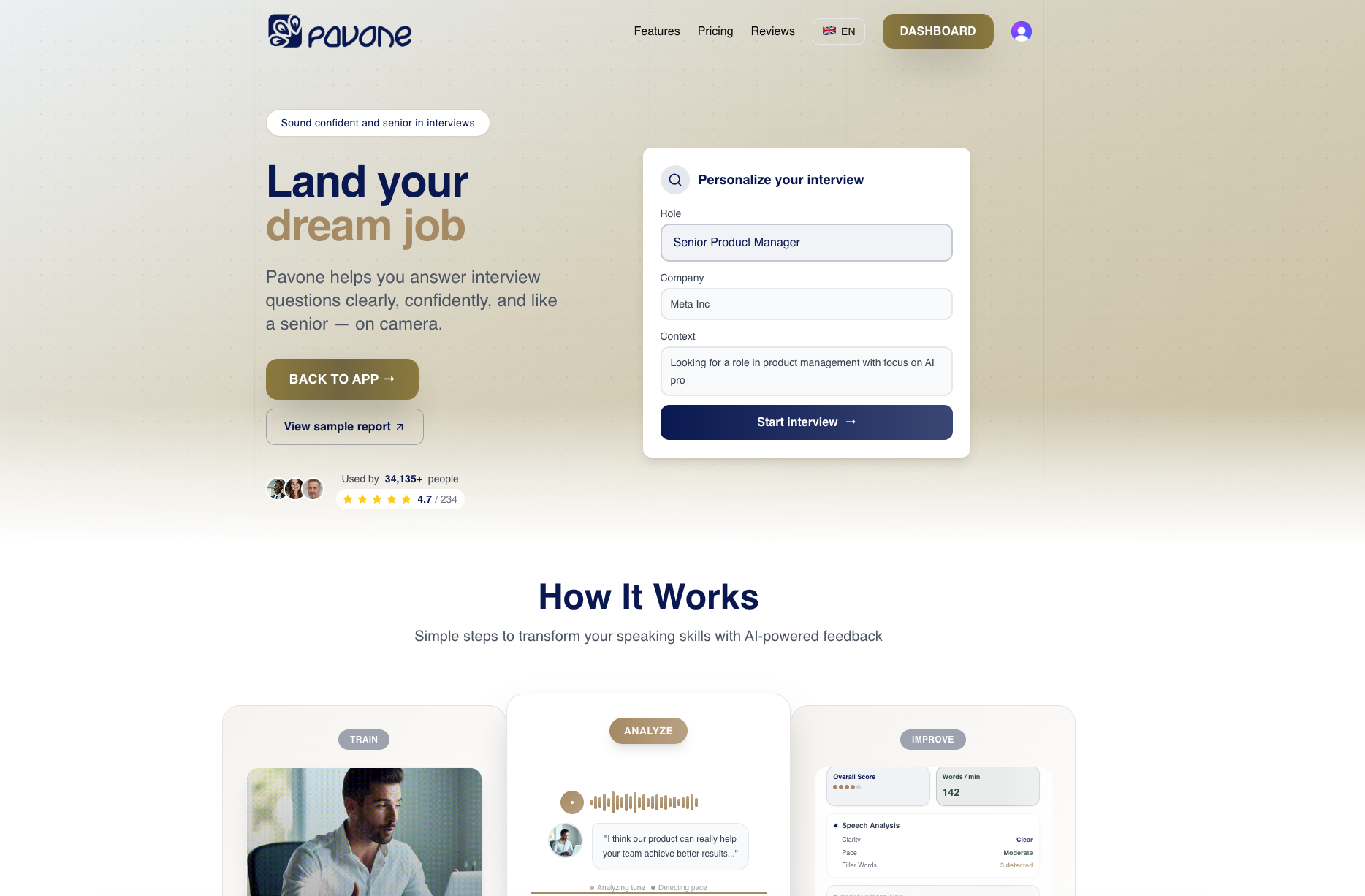
Ready to turn your interview preparation into a confident performance? Start practising today at Pavone.ai and experience the support of a personal interview coach available 24/7. Visit https://pavone.ai now and make your next interview your best one yet. Explore how our platform can help you transform interview anxiety into clear, compelling communication.
Frequently Asked Questions
What are some common interview questions to prepare for?
Common interview questions include inquiries about your greatest strengths, weaknesses, and experiences with challenging projects. Prepare answers using structured frameworks like STAR (Situation, Task, Action, Result) to effectively convey your skills and experiences.
How can I structure my answers to interview questions?
You can structure your answers using frameworks such as STAR or CAR (Context, Action, Result) to provide clarity and organisation in your responses. Practice these structures to help you present concise and impactful answers in approximately 2-3 minutes.
What should I do if I don’t know how to answer a question?
If you encounter a question you’re unsure about, take a moment to gather your thoughts and consider how your past experiences may apply. Use a structured response approach to convey any relevant skills or situations, even if they are not a perfect match.
How can I demonstrate my problem-solving skills in an interview?
To highlight your problem-solving skills, prepare specific examples from your work experience that showcase your analytical thinking and creativity. Describe the challenge, your approach, and the results achieved, aiming to quantify your impact whenever possible.
Why is it important to reduce filler words in my interview responses?
Reducing filler words enhances your credibility and clarity in communication. Practise deliberate pauses and become mindful of your speech patterns to improve the focus and impact of your answers, making your communication more confident and professional.
How can I create a strong closing statement for my interview?
A strong closing statement can summarise key points from the interview, express enthusiasm for the role, and highlight how your skills align with the company’s goals. Prepare and tailor a concise statement that reinforces your value and leaves a lasting impression on the interviewer.
Recommended
- How Do I Prepare for Interview: Achieve Clear Confident Delivery | Pavone Academy
- Corporate Interview Questions: Succeeding with Clarity | Pavone Academy
- Master Business Interview Questions and Answers for Senior Roles | Pavone Academy
- Interviewing for Mid and Senior Roles: Succeed with Confidence | Pavone Academy
- 7 Summer Jobs to Start Planning on Now for Students
Ready to practice?
Start improving your speaking skills with AI-powered feedback and analysis.
Try Pavone Free