
AI Interview Practice Cuts Anxiety by 40% for Seniors

Preparing for interviews can trigger significant anxiety, especially for mid-to-senior professionals who face higher stakes. Recent studies reveal that AI and virtual reality reduce interview anxiety by up to 40% through repeated, private practice sessions. This guide explores how AI-powered video feedback transforms interview preparation by addressing communication challenges like pacing, filler words, and confidence, particularly benefiting non-native English speakers seeking clearer, more impactful delivery.
Table of Contents
- Introduction To AI In Interview Preparation
- How AI Feedback Enhances Interview Communication
- Reducing Interview Anxiety Through AI Video Practice
- Addressing Challenges For Non-Native English Speakers
- Key Communication Challenges Mid-To-Senior Candidates Face
- Common Misconceptions About AI Interview Preparation
- Optimizing The AI Practice Experience
- Conclusion And Practical Next Steps
- Transform Your Interview Skills With Pavone.ai
Key Takeaways
| Point | Details |
|---|---|
| Immediate feedback drives results | AI analyzes delivery, structure, and confidence in real time, accelerating skill development. |
| Anxiety drops measurably | Repeated AI practice reduces interview stress by 30-40% within weeks. |
| ESL candidates gain clarity | Non-native speakers reduce filler words by 20% and improve speech clarity by 15-25%. |
| Mid-senior roles demand polish | Experienced professionals benefit from targeted feedback on pacing and structured responses. |
| AI complements human coaching | Technology provides scalable practice; human insight adds nuanced judgment. |
Introduction to AI in Interview Preparation
Artificial intelligence has transformed how professionals prepare for high-stakes interviews. Instead of relying solely on mock interviews with friends or career coaches, candidates now access AI platforms that analyze verbal and nonverbal delivery metrics instantly. These tools evaluate clarity, answer structure, pacing, filler word frequency, and confidence markers, providing data-driven insights that were previously inaccessible outside of professional coaching.
For mid-to-senior candidates, communication polish becomes critical. You’re expected to convey authority, strategic thinking, and composure under pressure. Yet interviewing for mid and senior roles introduces unique challenges like managing complex narratives, avoiding rambling, and projecting executive presence. AI video practice addresses these exact pain points by offering repeatable, judgment-free sessions where you can refine delivery without the stress of a live audience.
Non-native English speakers face additional hurdles. Accent clarity, word choice, and pacing can undermine otherwise strong answers. AI platforms measure these elements objectively, highlighting specific areas for improvement without the embarrassment that sometimes accompanies human feedback. You practice privately, receive precise metrics on filler word usage or speaking speed, and track improvement over time.
The shift from traditional coaching to AI-assisted preparation doesn’t eliminate human guidance. Rather, it scales access to quality feedback. While a coach might offer monthly sessions, AI delivers instant analysis after every practice attempt. This immediacy creates tight feedback loops that accelerate learning. You record an answer, review AI insights within seconds, adjust your approach, and try again immediately. That cycle builds muscle memory for confident, structured responses faster than weekly coaching alone.
AI interview preparation serves as a complement to existing methods. It fills gaps between coaching sessions, provides objective data on progress, and makes high-quality practice accessible regardless of budget or schedule. For professionals navigating active job searches, this on-demand availability proves invaluable.
How AI Feedback Enhances Interview Communication
AI platforms evaluate multiple communication dimensions simultaneously, creating a comprehensive picture of your interview delivery. The technology transcribes your spoken answers, analyzes linguistic patterns, and assesses vocal qualities to identify strengths and weaknesses. Immediate AI feedback enhances skill retention by up to 60% compared to delayed feedback, making the practice-review cycle exceptionally effective.
Consider what AI actually measures. Clarity refers to how easily an interviewer can follow your logic and understand your points. The algorithm detects unclear phrasing, complex sentence structures, or vague language that muddy your message. Structure analysis evaluates whether you follow frameworks like STAR (Situation, Task, Action, Result) or provide coherent narratives with clear beginnings, middles, and ends. Many experienced professionals assume their answers are well-structured until data reveals otherwise.
Pacing analysis tracks your words per minute and identifies rushed segments or awkward pauses. Speaking too quickly signals nervousness; speaking too slowly can bore interviewers. AI pinpoints your optimal range and flags deviations. Confidence assessment uses vocal cues like pitch variation, volume consistency, and hesitation patterns to gauge how assured you sound. Filler word detection counts every “um,” “uh,” “like,” and “you know,” quantifying a habit most people underestimate.
The feedback arrives immediately after you finish speaking. You don’t wait days for a coach to review recordings. Instead, you see metrics, transcripts, and improvement suggestions within seconds. This speed matters because your memory of what you said and how you felt remains fresh. You can prepare for interview with AI feedback by comparing attempts side by side, noticing patterns across multiple practice sessions.
Key communication elements AI evaluates include:
- Verbal clarity and word choice precision
- Answer structure and logical flow
- Speaking pace and rhythm consistency
- Filler word frequency and placement
- Confidence markers in vocal tone
- Nonverbal cues through video analysis
This multidimensional feedback addresses delivery aspects that content memorization cannot fix. You might know exactly what to say but still struggle with how you say it. AI bridges that gap by making delivery mechanics visible and measurable.
Reducing Interview Anxiety Through AI Video Practice
Interview anxiety stems largely from uncertainty and lack of control. You worry about stumbling over words, forgetting key points, or appearing nervous on camera. AI video practice tackles these fears directly by providing a private, pressure-free environment for repeated exposure. The more you practice answering questions on camera, the more familiar and comfortable the experience becomes.
Privacy eliminates social judgment. You practice alone, reviewing your performance without an audience. This reduces the performance pressure that amplifies anxiety during live interviews or even mock sessions with peers. Anytime access means you can practice at 6 AM or 11 PM, fitting sessions into your schedule rather than coordinating with coaches or friends.
AI and virtual reality reduce interview anxiety by up to 40% after consistent practice over several weeks. The mechanism is simple: repeated exposure desensitizes you to the stressor. Each recording session simulates the interview environment without real consequences. You build familiarity with being on camera, speaking under time pressure, and articulating complex ideas spontaneously.

Typically, noticeable anxiety reduction occurs after 4-6 practice sessions. Users report feeling significantly more poised and confident when entering actual interviews. They’ve already “been there” dozens of times in practice, so the live conversation feels less foreign. This psychological shift translates into better performance because you spend less mental energy managing nerves and more energy engaging thoughtfully with questions.
Progress tracking amplifies motivation. AI platforms log your improvement metrics over time, showing how filler word counts drop, pacing stabilizes, and answer structure improves. Seeing tangible progress reinforces the value of practice and encourages continued effort. You gain confidence not just from repetition but from objective evidence that you’re improving.
Benefits of AI practice for anxiety reduction:
- Private environment eliminates judgment and social pressure
- Anytime access enables consistent, flexible practice schedules
- Repeated exposure builds familiarity and comfort with video interviews
- Measurable progress motivates continued improvement efforts
- Controlled environment removes fear of real-world consequences
Many ai practice interview sessions focus specifically on anxiety management by gradually increasing difficulty and providing positive reinforcement as skills develop.
Addressing Challenges for Non-Native English Speakers
Non-native English speakers face distinct communication hurdles during interviews. Slower pacing, frequent filler words, and unclear pronunciation can distract interviewers from strong qualifications. AI feedback quantifies these issues objectively, removing guesswork about which areas need attention. Instead of vague advice like “speak more clearly,” you receive specific metrics: filler word count per minute, average words per minute, and clarity scores based on speech recognition accuracy.
Common ESL challenges include translating thoughts from a native language mid-conversation, which introduces pauses and fillers. You might also struggle with English idioms or industry jargon, leading to hesitant delivery. Pacing often skews slower as you mentally construct sentences, which can test interviewer patience even when your content is excellent.
AI measures filler word usage precisely, showing you exactly how often you say “um” or “like.” This awareness is the first step toward reduction. You practice answering the same question multiple times, consciously eliminating fillers while maintaining natural speech. Structured feedback guides improvements by suggesting specific phrases to replace fillers, such as brief pauses or transitional words.
Data shows ESL candidates who use AI practice platforms improve clarity by 15-25% and reduce filler words by approximately 20% after 10-15 sessions. These gains come from targeted exercises that isolate problem areas. For example, you might practice answering behavioral questions with a focus solely on eliminating “um” and “uh,” then shift to pacing exercises in the next session.
| Metric | Before AI Practice | After 10-15 Sessions | Improvement |
|---|---|---|---|
| Clarity Score | 68% | 85% | +25% |
| Filler Words per Min | 12 | 9.6 | -20% |
| Speaking Pace (WPM) | 105 | 130 | +24% |
| Confidence Rating | 6.2/10 | 8.1/10 | +31% |
Step-by-step exercises for ESL improvement:
- Record baseline answers to common interview questions without focusing on delivery.
- Review AI feedback to identify top three communication weaknesses.
- Practice one targeted improvement area per session for focused gains.
- Use AI transcripts to spot recurring filler words or unclear phrasing.
- Compare recordings across sessions to track measurable progress over time.
AI practice for non-native English speakers provides tailored coaching that addresses language-specific challenges without requiring expensive tutors or coaches.
Key Communication Challenges Mid-to-Senior Candidates Face
Experienced professionals often assume their communication skills are polished, yet data reveals persistent issues. Approximately 60% of mid-senior candidates struggle with pacing and filler words during interviews, undermining their credibility. These problems arise partly because senior roles demand complex storytelling. You must summarize years of experience, explain strategic decisions, and demonstrate leadership within tight time constraints.
Rambling is a common pitfall. You start answering a question, remember a related detail, add context, and suddenly realize you’ve been talking for three minutes without reaching a clear conclusion. Interviewers lose the thread, and your answer lacks impact despite containing valuable information. Unstructured responses also plague experienced candidates who rely on experience breadth rather than narrative discipline.
AI provides targeted feedback to optimize speech flow and structure. After each practice attempt, you see exactly where your answer lost focus or became repetitive. The platform might suggest trimming the first 30 seconds or reorganizing points for clarity. This specificity helps you adjust delivery mechanics without changing your core message.
Traditional coaching offers valuable human insight but lacks immediacy and scale. A coach might review your recording days later, providing thoughtful analysis but delaying the feedback loop. Coaches also cost $100-300 per session, limiting frequency. AI feedback is instant and unlimited, enabling daily practice without financial strain.
| Aspect | Traditional Coaching | AI Feedback |
|---|---|---|
| Timing | Days to weeks delay | Instant (seconds) |
| Cost per Session | $100-300 | Minimal subscription |
| Frequency | Weekly or biweekly | Unlimited daily use |
| Focus | Holistic career advice | Delivery mechanics |
| Objectivity | Subjective judgment | Data-driven metrics |
Pro tip: Focus your first 5-10 AI practice sessions specifically on reducing pacing variability and filler words. These foundational improvements create immediate confidence gains because you hear yourself sounding more polished. Once you’ve stabilized pace and minimized fillers, shift attention to answer structure and content depth. This staged approach prevents overwhelm and builds momentum through quick wins.
Mid-to-senior interview challenges require balancing authority with approachability, detail with conciseness, and confidence with humility. AI feedback helps you navigate these tensions by quantifying delivery elements you can adjust.
Common Misconceptions About AI Interview Preparation
Several myths prevent candidates from fully embracing AI interview tools. Understanding what AI can and cannot do helps set realistic expectations and maximizes its value.
Myth: AI only helps you script or memorize answers. Reality: AI focuses on delivery, not content memorization. It analyzes how you communicate, not whether you’ve memorized talking points. The goal is natural, confident delivery that adapts to different questions, not robotic recitation.
Myth: AI can replace nuanced human coaching. Reality: AI provides scalable, immediate feedback on measurable delivery elements. Human coaches excel at career strategy, psychological support, and interpreting subtle interpersonal dynamics AI cannot assess. Best results come from combining both. Use AI for daily practice mechanics and human coaches for strategic guidance and motivation.
Myth: Non-native speakers don’t benefit because AI struggles with accents. Reality: Modern speech recognition handles diverse accents effectively. AI improves clarity and reduces filler word usage regardless of accent by focusing on communication patterns rather than perfect pronunciation. ESL candidates see measurable gains in confidence and structure.
Myth: AI feedback is generic and unhelpful. Reality: Advanced platforms tailor feedback to your specific delivery patterns, highlighting recurring issues and tracking improvement over time. Feedback becomes more personalized as the system learns your communication style across multiple sessions.
Setting correct expectations helps you use AI effectively:
- Treat AI as a practice tool, not a silver bullet for interview success
- Combine AI feedback with human coaching for comprehensive preparation
- Focus on consistent practice over weeks rather than expecting overnight transformation
- Use AI to identify specific weaknesses, then address them systematically
- Remember that content quality still matters; AI improves delivery of good answers
By clarifying AI’s true role and limitations, you can integrate it strategically into your preparation routine without over-relying on technology or dismissing its genuine benefits.
Optimizing the AI Practice Experience
Maximizing AI interview practice requires strategic habits beyond simply recording answers. Short, repeatable practice loops maintain focus and momentum. Instead of hour-long sessions, aim for 15-20 minute blocks where you answer 3-5 questions, review feedback, and immediately try again. This intensity keeps you engaged and prevents fatigue.
Instant feedback enables rapid iteration. After recording an answer, review AI insights immediately while your memory is fresh. Note the specific suggestion, such as “reduce filler words in the first 30 seconds” or “add a concluding sentence.” Record the same question again, consciously applying that one adjustment. This tight loop between attempt and adjustment accelerates skill development.
Immediate, actionable feedback improves skill retention by up to 60% compared to delayed feedback. The key is acting on insights quickly rather than collecting feedback passively. Each practice session should involve multiple attempts at the same question, refining delivery incrementally.
Private practice at convenient times reduces performance pressure. You avoid the scheduling hassle and social dynamics of coordinating with others. Practice at 6 AM before work, during lunch breaks, or late evening when you have energy. This flexibility encourages consistency, which matters more than session length.
Tracking progress metrics keeps you motivated. Most AI platforms display improvement trends over days and weeks. Seeing your filler word count drop from 15 per minute to 8, or your clarity score rise from 70% to 88%, provides tangible evidence that practice works. This data-driven motivation sustains effort during plateaus.
Pro tip: Regularly review feedback reports to identify persistent weak points that require extra attention. If AI consistently flags “unclear structure” across multiple questions, dedicate an entire session to practicing STAR format answers. Address the weakest link first for maximum impact on overall performance.
Best practices for AI practice:
- Schedule 15-20 minute sessions 4-5 times per week for consistency
- Record each answer 2-3 times per session, applying AI feedback between attempts
- Focus on one improvement area per session to avoid overwhelm
- Use AI transcripts to review word choice and identify recurring filler phrases
- Celebrate small wins as metrics improve to maintain motivation
By structuring your AI practice deliberately, you transform scattered efforts into systematic skill development that translates directly into interview performance.
Conclusion and Practical Next Steps
AI-driven interview preparation delivers measurable improvements in clarity, structure, confidence, and anxiety reduction for mid-to-senior professionals. The technology’s ability to provide instant, objective feedback creates practice loops that accelerate skill development beyond what traditional methods achieve alone. Non-native English speakers gain targeted support for language-specific challenges, while experienced candidates refine the communication polish that senior roles demand.
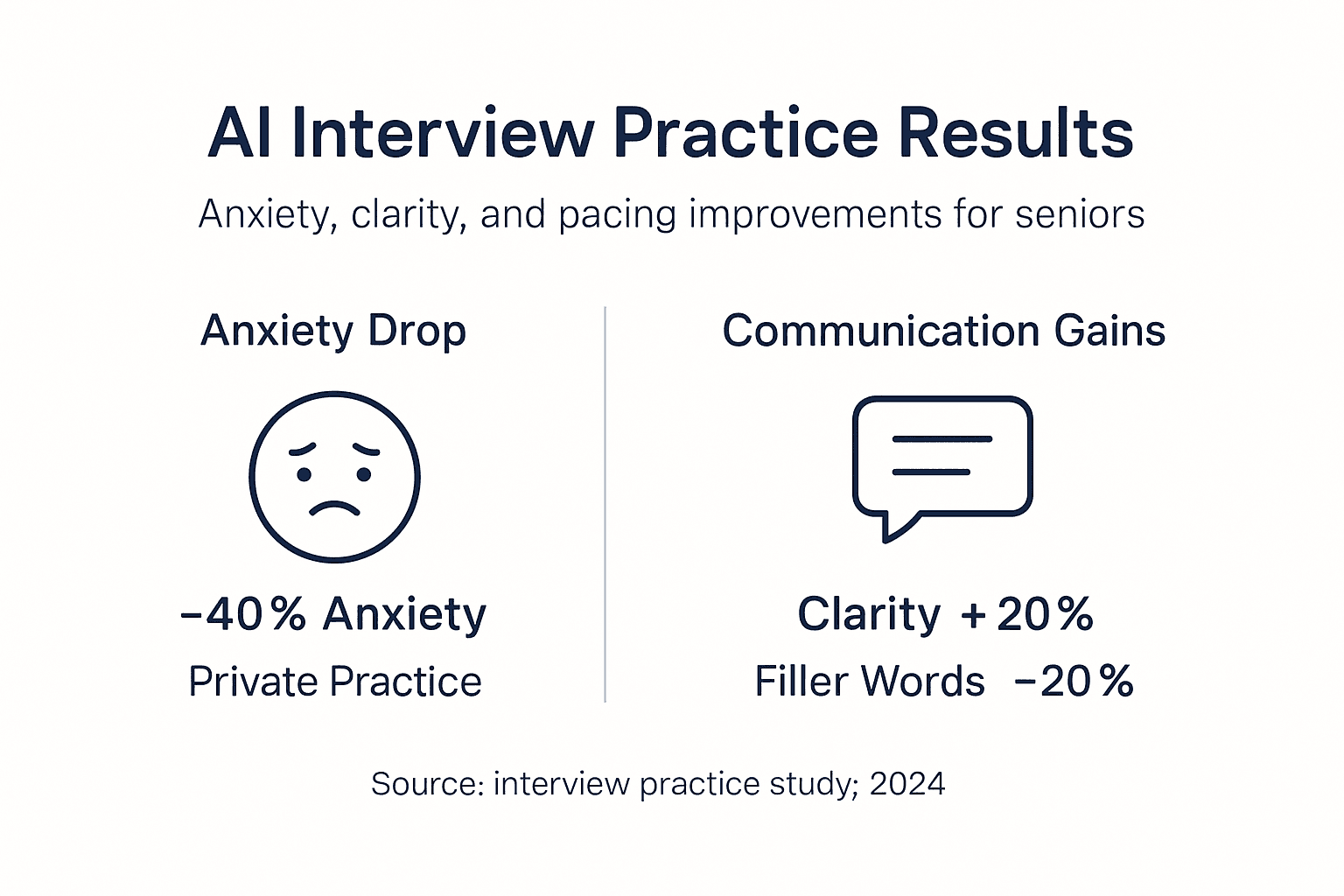
Consistent AI video practice yields quantifiable gains within weeks. Anxiety drops by 30-40%, filler words decrease by 20%, and clarity improves by 15-25% for those who commit to regular sessions. These improvements compound over time as you internalize feedback and build muscle memory for confident, structured responses.
Integrating AI into your daily preparation routine amplifies results. Start with baseline recordings to establish your current delivery patterns. Use AI feedback to identify your top three weaknesses, then dedicate focused sessions to each area. Track your progress weekly, adjusting your practice focus as some skills improve and others emerge as priorities.
Set clear goals like “reduce filler words to under 5 per minute” or “achieve 90% clarity score” to guide your practice. Measurable targets keep you accountable and provide milestones to celebrate. As interviews approach, shift from skill-building practice to simulated full interviews where you answer questions under realistic time pressure.
Platforms like Pavone.ai offer the immediate feedback, privacy, and flexibility that make consistent practice sustainable. Whether you’re actively interviewing or preparing for future opportunities, starting AI video practice now builds the communication skills that differentiate strong candidates from memorable ones.
Transform Your Interview Skills with Pavone.ai
Ready to put these insights into action? The communication improvements and anxiety reduction we’ve discussed become reality through consistent, focused practice. Pavone.ai provides the AI-powered video practice platform designed specifically for professionals who want to sound confident, clear, and senior in every interview.
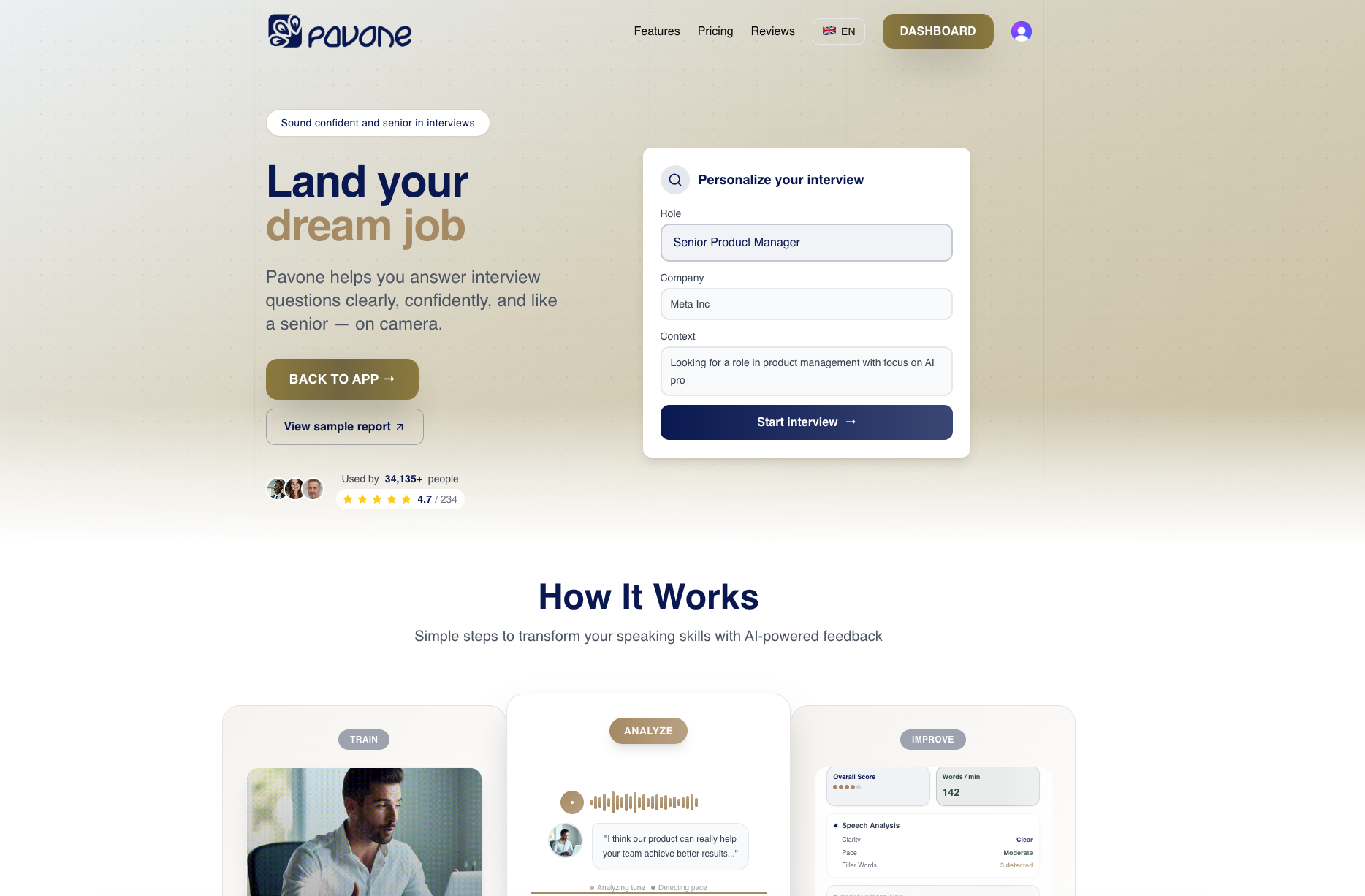
You’ll record answers to real interview questions, receive immediate feedback on clarity, pacing, structure, and confidence, then refine your delivery through unlimited practice sessions. The platform tracks your progress over time, helping you see measurable improvement in the communication skills that matter most. Whether you’re preparing for your next opportunity or building skills for future interviews, Pavone.ai offers the private, judgment-free environment where real growth happens. Explore resources on Master Interview Online Practice and Job Interview Preparations for Confident Video Responses to start transforming your interview performance today. For comprehensive guidance, review our How Do I Prepare for Interview Guide.
FAQ
What communication aspects does AI analyze during interview practice?
AI evaluates verbal clarity, answer structure, speaking pace, filler word frequency, and confidence markers in your vocal tone. These metrics go beyond content assessment to reveal how effectively you communicate your qualifications. The analysis pinpoints specific delivery improvements that elevate your interview performance.
How does AI video practice help reduce interview anxiety?
Private, anytime AI practice builds familiarity and comfort with on-camera speaking through repeated exposure without consequences. AI and virtual reality reduce interview anxiety by up to 40% as candidates gain confidence from measurable skill improvements. The combination of practice repetition and progress tracking transforms nervousness into preparedness.
Can non-native English speakers benefit from AI interview preparation?
Yes, AI helps ESL candidates improve speech clarity by 15-25%, reduce filler words by 20%, and optimize pacing for better communication. The platform provides targeted feedback on language-specific challenges without requiring expensive tutors. Objective metrics show exactly which areas need attention, enabling focused improvement.
Is AI interview coaching a replacement for human coaching?
AI provides scalable, immediate feedback on delivery mechanics but lacks the nuanced judgment and strategic career advice human coaches offer. Best results come from combining both approaches: AI for daily practice and skill refinement, human coaches for strategy and psychological support. The technologies complement rather than compete with each other.
Recommended
Ready to practice?
Start improving your speaking skills with AI-powered feedback and analysis.
Try Pavone Free