
Anxious About Job Interview – Practical Strategies for Tech Professionals

Stepping into a job interview, especially for a mid-level tech role, often brings a rush of nerves shaped by more than just technical questions. For non-native English speakers, unique pressure comes from juggling language skills, cultural nuances, and unpredictable interviewer expectations. Recognising the true causes of your anxiety—whether it’s fear of judgement, career uncertainty, or communication barriers—paves the way to developing practical strategies and building real confidence for your next interview.
Table of Contents
- What Causes Job Interview Anxiety
- Unique Challenges For Non-Native Tech Candidates
- How Anxiety Impacts Interview Performance
- Effective Communication And Practice Techniques
- Common Pitfalls And Solutions In Preparation
Key Takeaways
| Point | Details |
|---|---|
| Understanding Anxiety Triggers | Identifying specific sources of anxiety, such as fear of judgment or uncertainty, helps in preparing targeted strategies for interviews. |
| Importance of Preparation | Thorough preparation, including role research and practising common questions, significantly reduces anxiety and boosts candidate confidence. |
| Non-verbal Communication Awareness | Managing visible signs of anxiety through controlled body language and clear pacing is crucial for making a positive impression during interviews. |
| Feedback Loop in Practice | Engaging in repeated practice with feedback is essential for improving communication skills and overcoming common pitfalls in interview preparation. |
What Causes Job Interview Anxiety
Job interview anxiety doesn’t appear out of nowhere. It stems from a combination of psychological, social, and practical factors that uniquely affect tech professionals preparing for mid-level roles.
Understanding what triggers your anxiety is the first step toward managing it effectively. When you can identify the specific sources of your stress, you can address them with targeted strategies rather than trying to manage a vague sense of dread.
The Root Causes
Research identifies several key factors that contribute to interview-related stress:
-
Uncertainty about the outcome. You cannot control whether the interviewer likes you or decides to hire someone else. This unpredictability creates genuine anxiety.
-
Fear of judgment. Sitting across from a stranger who will evaluate your abilities and fit feels uncomfortable. The fear extends beyond technical assessment to social evaluation.
-
Preparation gaps. If you feel unprepared—whether due to limited time, unclear job requirements, or weak communication skills—anxiety naturally follows.
-
Economic pressure. Especially for non-native English speakers navigating global opportunities, a job interview may represent significant financial stakes. The weight of this pressure intensifies anxiety.
-
Career uncertainty. Broader labour market uncertainty and changing employment landscapes heighten overall career anxiety, making individual interviews feel higher-stakes.
For tech professionals specifically, additional stressors include technical question uncertainty, imposter syndrome (particularly common among non-native English speakers), and concerns about communication clarity under pressure.
Here’s a summary of main anxiety triggers and targeted coping strategies for tech interviewees:
| Anxiety Trigger | Who Feels It Most | Practical Coping Strategy |
|---|---|---|
| Uncertainty about outcome | All tech candidates | Focus on preparation, not outcome |
| Fear of judgement | Non-native speakers, all | Practise positive self-talk |
| Technical question uncertainty | Tech professionals | Mock interviews with peers |
| Communication clarity under stress | Non-native speakers | Record and review responses |
| Economic/career pressure | Non-native candidates | Plan interview schedule carefully |
Why Tech Professionals Feel It More Intensely
Tech interviews often combine multiple anxiety triggers simultaneously. You face technical questions alongside behavioural assessments, all whilst being recorded or scrutinised.
Non-native English speakers experience additional pressure. Speaking clearly whilst thinking through complex concepts demands cognitive resources. This multifaceted stress—from psychological, social, and professional expectations—significantly impacts confidence and readiness.
The pressure compounds when you’re competing against candidates from English-speaking backgrounds. You may worry that your accent or pacing will disadvantage you, even when your technical knowledge is equivalent.
The Anxiety Cycle
Anxiety often creates its own momentum. Worry about performance can impair actual performance through distraction, nervous verbal patterns (filler words, rushed speech), and difficulty accessing your knowledge under stress.
This cycle makes pre-interview preparation feel urgent yet challenging—exactly when you need steady focus most.
Understanding these causes transforms anxiety from an abstract threat into manageable, specific challenges you can prepare for.
Pro tip: Write down three specific causes of your anxiety (for example, “speaking clearly under pressure” or “technical question uncertainty”) and focus your preparation on just those areas rather than trying to improve everything at once.
Unique Challenges for Non-native Tech Candidates
As a non-native English speaker pursuing mid-level tech roles, you face obstacles that native speakers simply don’t encounter. These challenges are real, measurable, and manageable once you understand them.
The good news? Awareness and targeted preparation can neutralise most of these disadvantages. You’re not starting from behind—you’re starting differently.
Language Processing Under Pressure
Non-native speakers typically spend substantially more time processing English, especially when under stress. During an interview, you’re simultaneously thinking about your answer, translating concepts mentally, and monitoring your pronunciation.
This cognitive load is real. A native speaker processes the question and answers. You process the question, translate internal thoughts to English, and deliver—all whilst maintaining composure.

The result? You may need extra seconds to formulate responses. Interviewers sometimes misinterpret this pause as uncertainty rather than thoughtfulness.
This table compares interview communication challenges for native and non-native tech candidates:
| Challenge Type | Native Speakers | Non-native Speakers |
|---|---|---|
| Language processing | Direct understanding | Translation and clarity required |
| Cultural norms | Familiar, instinctive | Need to interpret and adapt |
| Pacing and tone | Natural conversational rhythm | Must monitor and adjust consciously |
| Confidence expression | Linguistic fluency aids confidence | Confidence may be hindered by language |
Communication Barriers Beyond Accent
Accent receives attention, but the deeper challenge lies elsewhere. Non-native English speakers encounter difficulties in professional communication settings, including interviews where nuance and clarity matter.
You might struggle with:
-
Explaining complex technical concepts clearly in a non-native language under time pressure.
-
Understanding cultural communication norms that interviewers expect but never explicitly state.
-
Matching conversational pace and tone that native speakers use instinctively.
-
Expressing confidence linguistically when your language skills feel like a limitation.
Unconscious Bias and Discrimination
Research shows that non-native English speakers face discrimination and barriers in employment interviews. This isn’t about your technical ability—it’s about how interviewers unconsciously evaluate you differently.
You might be exceptionally qualified, yet an interviewer forms judgements based on accent or pacing before you’ve demonstrated competence. This reality is frustrating, but recognising it helps you prepare strategically.
Preparation Time Reality
You likely require more preparation than native-speaking peers. This isn’t a weakness—it’s statistical reality. Accepting this means planning accordingly rather than feeling pressured to match someone else’s timeline.
The challenge isn’t your capability. It’s the additional cognitive and communicative load you carry during interviews.
Pro tip: Record yourself answering interview questions and focus specifically on clarity and pacing rather than accent—these are controllable factors that significantly impact how interviewers perceive your competence.
How Anxiety Impacts Interview Performance
Anxiety doesn’t just feel uncomfortable—it actively sabotages your interview performance. The relationship between anxiety and outcomes is direct and measurable, which means understanding this connection gives you power to counteract it.
Your anxiety doesn’t reflect your actual competence. But it does affect how you communicate that competence to interviewers.
The Nonverbal Behaviour Chain
When anxiety strikes, your body communicates it before your mouth does. Anxious nonverbal behaviours such as nervous gestures and hesitation directly lower how interviewers rate candidates.
Your interviewer may unconsciously downrate your qualifications based purely on how nervous you appear, regardless of your actual technical ability. This happens automatically—they’re not deliberately penalising you.
Common anxious behaviours include:
-
Fidgeting, tapping fingers, or restless hand movements.
-
Speaking too quickly or with excessive pauses and filler words.
-
Avoiding eye contact or looking down frequently.
-
Rigid posture or appearing physically tense.
Communication Collapse Under Pressure
Anxiety triggers avoidance behaviours and emotional dysregulation that impair how you engage with interviewers. Your knowledge remains intact, but accessing it becomes harder.
You might:
-
Struggle to articulate ideas you know perfectly well.
-
Forget key examples or accomplishments you’d planned to mention.
-
Speak in incomplete sentences or jump between thoughts.
-
Appear less engaged or enthusiastic than you actually feel.
For non-native speakers, this effect amplifies. Your cognitive load already requires managing language production. Add anxiety, and clear communication becomes significantly harder.
The Fear of Negative Evaluation
Social anxiety creates fear of negative evaluation, which reduces your ability to showcase your skills and qualifications effectively. You become hyperaware of how you’re being judged, which creates a self-fulfilling prophecy.
You worry about being perceived as inadequate, so you hold back. You don’t ask clarifying questions. You don’t expand on accomplishments. You don’t bring your full self to the conversation.
Interviewers interpret this withdrawal as lack of confidence or interest.
The Performance Gap
Here’s the critical insight: anxiety creates a gap between what you know and what you can demonstrate. Closing that gap is entirely possible through targeted preparation.
Anxiety doesn’t prove you’re unprepared. It proves you need specific strategies to communicate your qualifications clearly under pressure.
Pro tip: Before your interview, practise speaking your answers aloud on camera and watch yourself—this desensitises you to seeing yourself nervous and helps you identify specific nonverbal behaviours to correct.
Effective Communication and Practice Techniques
Closing the gap between what you know and what you can demonstrate requires deliberate practice and strategic communication improvements. The techniques here are proven to reduce anxiety and elevate your performance measurably.
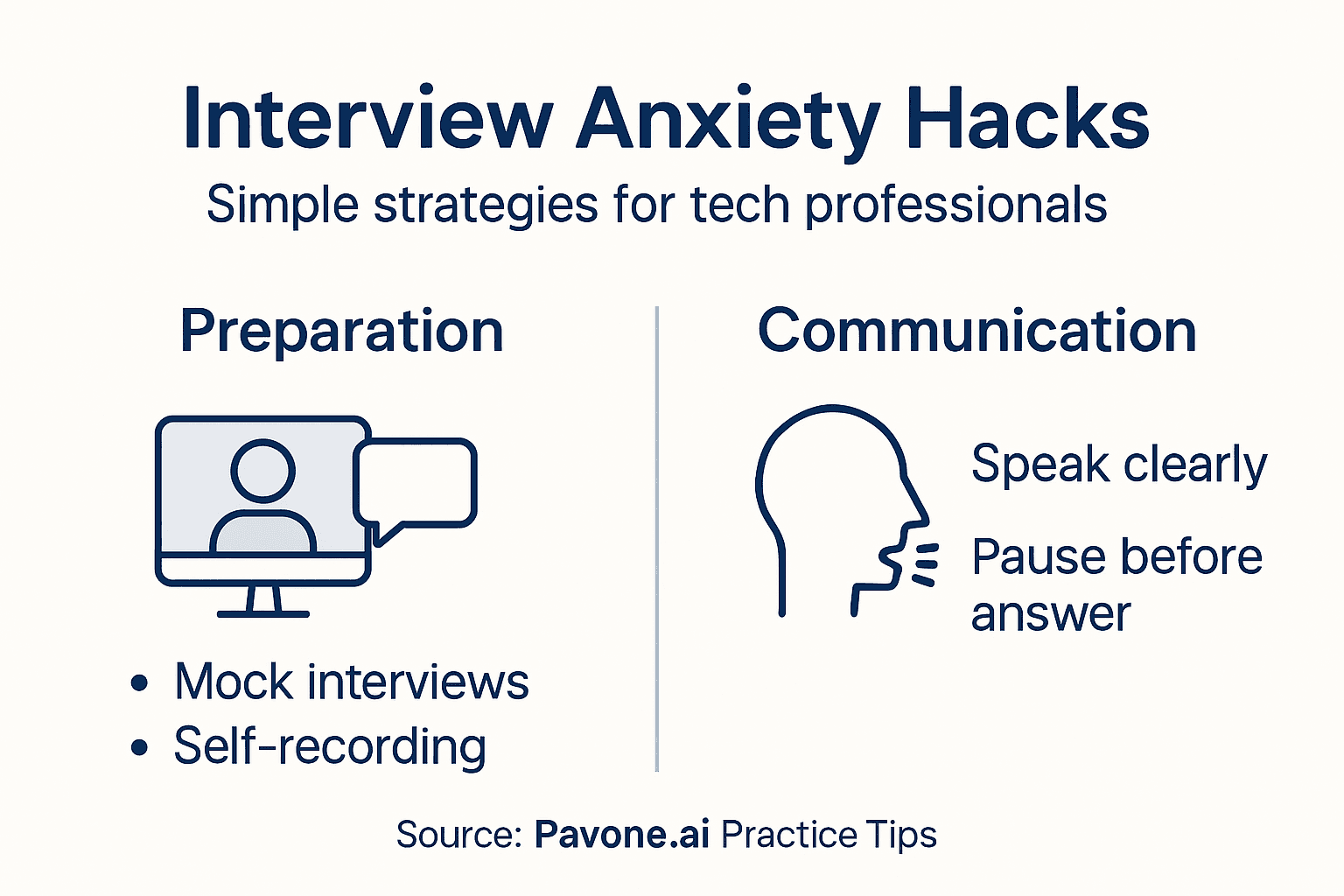
You won’t become fluent overnight. But consistent, focused practice transforms how confidently you communicate under pressure.
Preparation as Anxiety Antidote
Thorough preparation including company research, role understanding, and practising common questions significantly improves candidate impressions. This isn’t busy work—preparation directly reduces anxiety because knowledge builds confidence.
Start with specifics:
-
Research the company’s recent products, news, and culture.
-
Understand the role requirements and identify where your experience aligns.
-
Practise answering 10-15 common questions tailored to the position.
-
Prepare specific examples using the STAR method (Situation, Task, Action, Result).
When you’ve done this work, your anxiety shifts from “Will I know what to say?” to “How will I best present what I know?”
Controlling Your Verbal Delivery
Pacing is the single biggest controllable factor in how interviewers perceive your competence. Non-native speakers often rush or add filler words when anxious.
Focus on these elements:
-
Speak deliberately, with intentional pauses between thoughts.
-
Aim for a natural conversational pace, not rapid-fire responses.
-
Eliminate filler words (umm, ah, like, you know) through conscious awareness.
-
Use silence confidently—a 2-second pause feels natural to listeners, even if it feels long to you.
Nonverbal Communication Control
Your body language communicates before your words do. Manage these visible anxiety signals:
-
Maintain an open posture: shoulders back, sitting upright, hands visible.
-
Make regular eye contact with the interviewer (if in-person) or look directly at the camera (if virtual).
-
Keep hands still and purposeful rather than fidgeting.
-
Smile naturally when appropriate—it signals confidence and engagement.
The Practice-Feedback Loop
Recording yourself answering interview questions is uncomfortable but transformative. You see exactly what interviewers see: your pacing, facial expressions, gestures, and filler words.
This visibility creates rapid improvement. Most candidates notice measurable changes within 3-5 practice attempts.
Practice with real feedback isn’t optional for reducing anxiety. It’s the difference between hoping you’ll improve and knowing you are improving.
Pro tip: Record three practice answers, then watch each one and count your filler words and pauses—focusing on one specific improvement per recording makes feedback actionable rather than overwhelming.
Common Pitfalls and Solutions in Preparation
Most candidates don’t fail interviews because they lack technical ability. They fail because they fall into predictable preparation mistakes that undermine their performance. Recognising these pitfalls helps you avoid them.
The good news? These mistakes are entirely preventable with awareness and deliberate action.
Insufficient Research and Role Understanding
Many candidates approach interviews with surface-level knowledge about the company or role. You might know the company exists but not what they’ve launched recently or what their culture actually values.
Instead, prepare specifically:
-
Review the company’s last 3-4 press releases or product launches.
-
Understand the team structure and who you’d be reporting to.
-
Identify 2-3 genuine reasons why this role excites you.
-
Research the technical stack and current challenges the role addresses.
This depth transforms your answers from generic to specific, which interviewers immediately recognise.
Under-Preparation for Technical and Behavioural Questions
Tech interviews combine two distinct question types, and candidates often over-prepare for one whilst neglecting the other. Technical questions feel safer, so behavioural questions sometimes receive less attention.
Both matter equally. Interviewers assess your technical competence and your ability to communicate, collaborate, and solve problems under pressure.
Prepare thoroughly for:
-
Technical questions specific to your role level and tech stack.
-
Behavioural questions using STAR method examples from your actual experience.
Mix your practice evenly between both types.
The Confidence Trap
Overconfidence and underconfidence are two sides of the same pitfall. Overconfident candidates skip preparation, assuming their skills speak for themselves. Underconfident candidates prepare obsessively yet dismiss their own qualifications.
Neither serves you. Successful preparation requires realistic self-assessment—acknowledging your genuine strengths whilst identifying gaps that need work.
For non-native speakers especially, underconfidence often masks genuine capability. You know more than you’re comfortable articulating. This requires practice, not additional study.
Ignoring the Feedback-Learning Loop
Most candidates practice answers once or twice, then feel “ready.” This creates false confidence. Real mastery comes from repeated practice with feedback, measuring improvement specifically.
Without feedback, you can’t distinguish between what’s working and what needs adjustment. You might repeat the same filler words or pacing issues across every practice attempt.
Preparation without feedback is practice. Preparation with feedback is progress.
Pro tip: After recording each practice answer, identify one specific element to improve in the next attempt—whether that’s eliminating a filler word, slowing your pacing, or expanding on a key example.
Overcome Interview Anxiety with Targeted Practice on Pavone.ai
The article highlights the intense anxiety tech professionals face during job interviews, especially non-native English speakers struggling with clarity, pacing, and confidence under pressure. If you find yourself challenged by pauses, filler words, or nervous nonverbal signals undermining your true competence, you are not alone. Pavone.ai offers a personalised, private environment to practise speaking on camera, helping you build clarity and reduce anxiety through actionable, AI-driven feedback focused on how answers are delivered rather than just content.
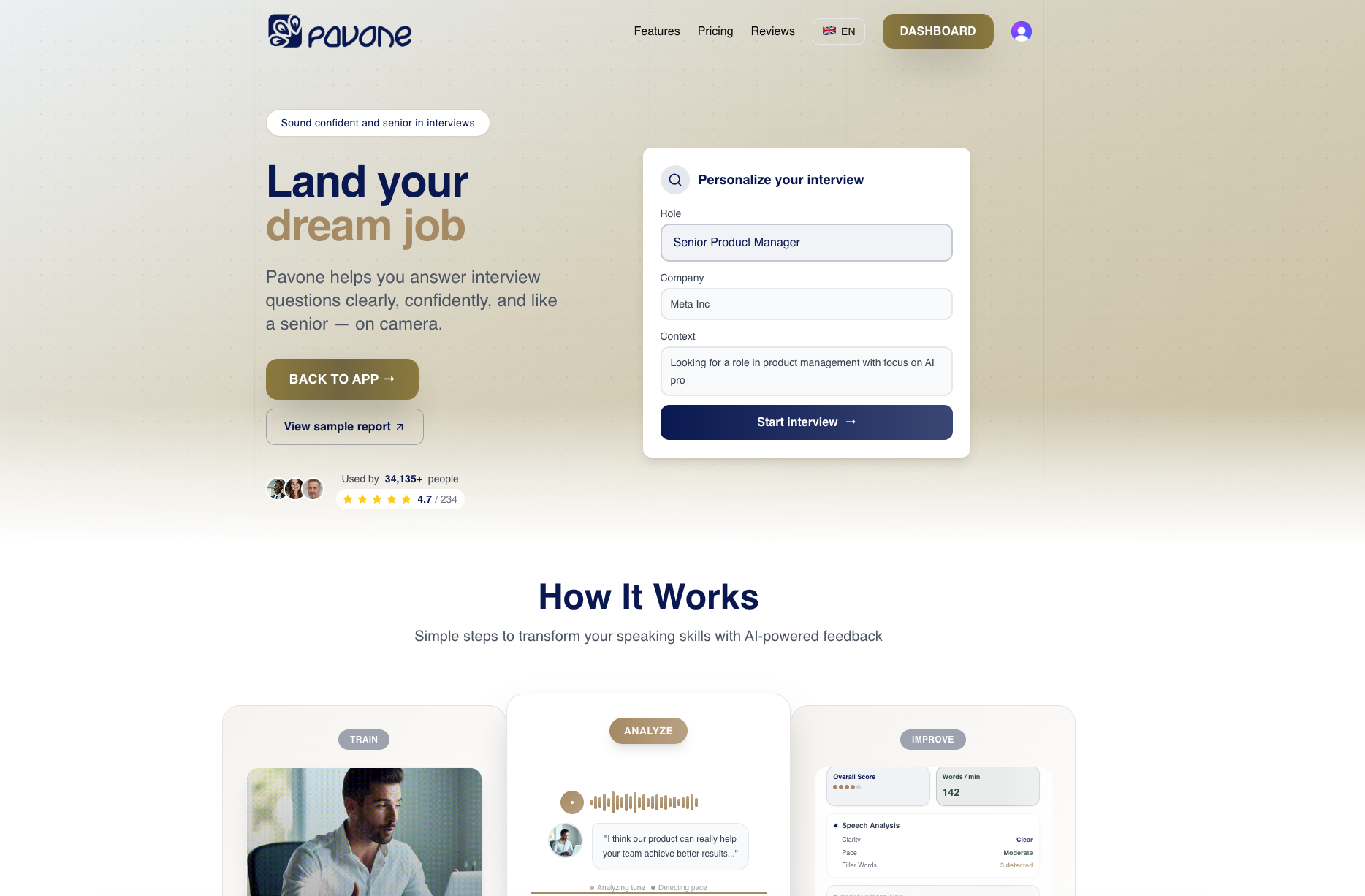
Take control of your interview preparation now with Pavone.ai and turn anxiety into assurance. Record your answers anytime, analyse your pacing, confidence, and word choice, then track measurable improvement over time. Stop letting nervousness hold you back from showcasing your skills. Begin your journey to clearer, more confident interviews today at Pavone.ai and experience the power of a personal 24/7 interview coach dedicated to your success.
Frequently Asked Questions
What are the main causes of job interview anxiety for tech professionals?
Job interview anxiety for tech professionals can stem from several factors, including uncertainty about the outcome, fear of judgement, preparation gaps, economic pressure, and career uncertainty. Non-native English speakers may experience additional stress due to language processing challenges.
How can I manage my job interview anxiety effectively?
To manage job interview anxiety, focus on thorough preparation, practice positive self-talk, and engage in mock interviews. Identifying specific triggers of your anxiety, such as technical question uncertainty or communication clarity, allows for targeted strategies.
What strategies can help non-native English speakers perform better in job interviews?
Non-native English speakers can benefit from recording their responses to practice clarity and pacing, preparing specific examples using the STAR method, and researching the company and role in depth. This targeted preparation helps to build confidence and reduce performance anxiety.
How does anxiety impact interview performance?
Anxiety can negatively affect interview performance by impairing communication skills, causing nervous behaviours, and leading to a disconnect between knowledge and demonstration of skills. Candidates often find it difficult to articulate their ideas or forget key examples when anxious, which can be mitigated through practice and preparation.
Recommended
- Anxiety and Interviews – Impact on Performance | Pavone Academy
- Job Interview Preparation: Achieving Confident Delivery | Pavone Academy
- How to Speak Confidently in Job Interviews - Pavone
- Body Language in Interviews: Boosting Tech Careers | Pavone Academy
Ready to practice?
Start improving your speaking skills with AI-powered feedback and analysis.
Try Pavone Free