
Interview Practice: Building Confidence On Camera

Facing a technical interview often means juggling complex coding tasks and behavioural questions under real pressure. For ambitious professionals aiming for senior positions in IT and software engineering, balancing technical accuracy with confident communication can feel challenging—especially for non-native speakers. This guide explains how combining structured practice with camera-based feedback uncovers blind spots, helping you sound clear and credible while mastering both technical and behavioural interview formats. For tech roles, targeted practice on camera transforms your preparation from silent rehearsal to real-world readiness.
Table of Contents
- Interview Practice For Tech Roles Explained
- Why Camera-Based Practice Matters For Tech Candidates
- The Two Layers Of Tech Interview Practice
- Types Of Interview Practice And Variations
- Structured Versus Flexible Practice Formats
- Live Versus Asynchronous Recording Formats
- Technical Scenario Versus Behavioural Variations
- How Pavone Analyzes And Improves Answers
- Content Structure And Response Framework
- Delivery Metrics And Speaking Patterns
- Actionable Feedback Cycles
- Critical Factors For Non-Native Professionals
- The Articulation And Pacing Challenge
- Managing Cognitive Load During Delivery
- Cultural Communication Norms And Expectations
- Common Pitfalls And Best Practice Strategies
- The Preparation And Research Gap
- Rushing And Unclear Structure
- Neglecting Delivery Practice
- Authenticity Versus Over-Preparation
Key Takeaways
| Point | Details |
|---|---|
| Practice Both Technical and Communication Skills | Effective tech interview preparation encompasses both solving problems and clearly articulating solutions. Leverage camera practice to improve both aspects simultaneously. |
| Utilise Asynchronous Recording for Self-Analysis | Recording responses allows candidates to identify and address weaknesses in presentation and articulation before interviews. Regular review can enhance overall performance. |
| Balance Structured and Flexible Practice Formats | Combining structured practice for consistency with flexible formats for adaptability builds resilience and confidence in interviews. Tailor practice sessions to cover both styles. |
| Research the Company Thoroughly | Prior to interviews, candidates should familiarise themselves with the company’s products, recent initiatives, and technical challenges to create impactful and relevant responses. |
Interview practice for tech roles explained
Interview practice for tech roles is fundamentally different from general job interview preparation. Tech roles—whether software engineering, data science, cloud architecture, or DevOps—combine behavioural interviews with technical assessments, making targeted practice essential.
Here’s what sets tech interviews apart:
- Technical assessments test your coding ability, system design knowledge, or problem-solving approach under time pressure
- Behavioural questions evaluate how you communicate, collaborate, and handle challenges in real projects
- Live coding or whiteboarding requires you to think aloud whilst writing code, which feels unnatural without rehearsal
- Company-specific formats range from at-home assignments to live coding sessions with multiple interviewers
Effective interview practice for tech roles follows a structured technical interview framework, covering both technical depth and communication clarity. You’re not just solving problems—you’re demonstrating how you solve them.
Why camera-based practice matters for tech candidates
Recording yourself answering interview questions reveals blind spots you cannot see in your head. When you speak aloud without recording, your brain fills in gaps. On camera, you hear exactly what an interviewer hears: filler words, hesitations, unclear explanations, or rushed delivery.
For tech roles specifically, camera practice helps you:
- Notice when you’re explaining code or architecture unclearly to someone without your technical background
- Catch nervous habits that distract from your technical credibility
- Practise speaking at a sustainable pace instead of rushing through answers
- Build familiarity with video interview formats before the real thing
Recording yourself transforms vague self-awareness into concrete, actionable feedback. You hear exactly what interviewers hear.
Most technical candidates focus entirely on the problem itself—the algorithm, the system design, the solution. They neglect how they communicate their thinking. On camera, you quickly realise that solving the problem correctly but explaining it poorly creates doubt about your actual technical depth.
The two layers of tech interview practice
Tech interview preparation requires attention to both technical accuracy and communication quality. AI-driven interview systems simulate real scenarios with adaptive feedback on both verbal and non-verbal cues, allowing you to refine your delivery alongside your technical response.
Your practice should address:
- Technical layer: Can you solve the problem correctly within time constraints?
- Communication layer: Can you explain your approach clearly, acknowledge trade-offs, and respond to interviewer feedback?
Most candidates excel at one and struggle with the other. Recording practice sessions on camera forces you to develop both simultaneously, rather than practising coding separately from interview delivery.

Pro tip: After each practice session, review the recording with these three questions: Did I explain my logic clearly enough for a non-specialist to follow? Did I speak at a natural pace? Did I address the interviewer’s concerns directly?
Types of interview practice and variations
Interview practice comes in several formats, each serving a different purpose in your preparation journey. Understanding which type to use—and when—helps you build confidence more efficiently than randomly practising everything.
The main variations differ in structure, format, and how closely they mirror the actual interview experience. Some are rigid and controlled; others are flexible and exploratory. Most effective preparation combines multiple types.
Structured versus flexible practice formats
Structured interviews follow standardised questions in set order, while flexible formats allow conversational flow and follow-up questions. For tech roles, this distinction matters because real interviews contain both elements.
Structured practice involves:
- Practising the same interview questions repeatedly to refine your response
- Recording yourself answering standardised questions like “Tell me about your most complex project”
- Timing your answers to fit within typical response windows (usually 2–3 minutes)
- Building consistency and clarity through repetition
Flexible practice involves:
- Having conversations with mentors or peers who ask follow-up questions
- Practising how you pivot when an interviewer challenges your answer
- Responding to unexpected angles on familiar topics
- Developing adaptability rather than memorised responses
Structured practice builds confidence through repetition. Flexible practice builds resilience through unpredictability.
Here is a comparison of structured and flexible interview practice for tech roles:
| Practice Style | Main Focus | Typical Use Case | Key Benefit |
|---|---|---|---|
| Structured Practice | Refined, consistent responses | Predictable interview questions | Boosts confidence through repetition |
| Flexible Practice | Adaptive, conversational answers | Unplanned follow-ups or behavioural queries | Enhances resilience and authenticity |
The strongest candidates practise both: structured answers for consistency, flexible conversations for authenticity.
Live versus asynchronous recording formats
Live practice happens in real time with another person—a peer, mentor, or mock interviewer. You receive immediate feedback and can adjust your approach mid-conversation. This mirrors the actual interview experience most closely but requires scheduling and coordination.
Asynchronous recording means you record yourself answering questions alone, then review the footage. You control the timing, can repeat as many times as needed, and analyse your delivery in detail. This feels lower-pressure initially but requires honest self-evaluation.
For non-native English speakers in tech roles, online interview practice tools offer asynchronous recording with immediate analysis of clarity, pacing, and filler words—giving you concrete feedback on how your communication lands.
Technical scenario versus behavioural variations
Tech interviews split into two distinct types, each requiring different practice approaches:
Technical scenario practice covers:
- Live coding or whiteboarding problems
- System design discussions
- Debugging exercises
- Problem-solving walkthroughs
Behavioural scenario practice covers:
- Project retrospectives and lessons learnt
- Conflict resolution and collaboration stories
- Leadership and decision-making examples
- Failure recovery and growth narratives
Most candidates over-practise technical scenarios and under-practise behavioural delivery. Both require recording yourself to notice how you explain, not just what you know.
Pro tip: Mix your practice types weekly: two structured sessions on specific questions, one flexible conversation with a peer, and one technical live-coding session to keep your preparation balanced and engaging.
How Pavone analyses and improves answers
When you record an answer on Pavone, the platform immediately begins analysing multiple dimensions of your response—not just what you said, but how you said it. This dual focus on content and delivery is what transforms practice into measurable improvement.
The analysis happens across three core areas: structure, clarity, and delivery. Each feeds into the next, creating a feedback loop that targets your weakest communication points.
Content structure and response framework
Pavone evaluates whether your answer follows a logical structure that interviewers expect. For behavioural questions, this means checking alignment with the STAR method—Situation, Task, Action, Result. For technical questions, it assesses whether you explain your approach before diving into implementation details.
Structure analysis includes:
- Does your answer have a clear beginning, middle, and end?
- Do you explain the “why” behind your decisions, not just the “what”?
- Do you quantify results where possible (timelines, metrics, impact)?
- Do you acknowledge trade-offs or limitations in your approach?
Structured responses build credibility. An interviewer listening to a well-organised answer trusts your thinking even before evaluating technical depth. Pavone identifies where your narratives lack organisation, helping you add signposting and clarity.
Delivery metrics and speaking patterns
AI-powered analysis evaluates clarity, pacing, and confidence through metrics like filler word frequency and speech rate. These subtle factors determine how senior or uncertain you sound.
Pavone measures:
- Filler words (“um,” “uh,” “like,” “you know”) that distract from content
- Speech pace to ensure you’re speaking naturally, not rushing or dragging
- Pause patterns that show confidence or uncertainty
- Clarity of articulation for non-native English speakers to ensure every word lands
You might explain a complex concept perfectly, but if you’re speaking too quickly or using frequent fillers, interviewers perceive uncertainty. Pavone quantifies these patterns so you can hear exactly what needs adjustment.
Delivery often matters more than content. Two equally knowledgeable candidates: one sounds senior, the other sounds junior. The difference is pacing, clarity, and confidence—all measurable and trainable.
Actionable feedback cycles
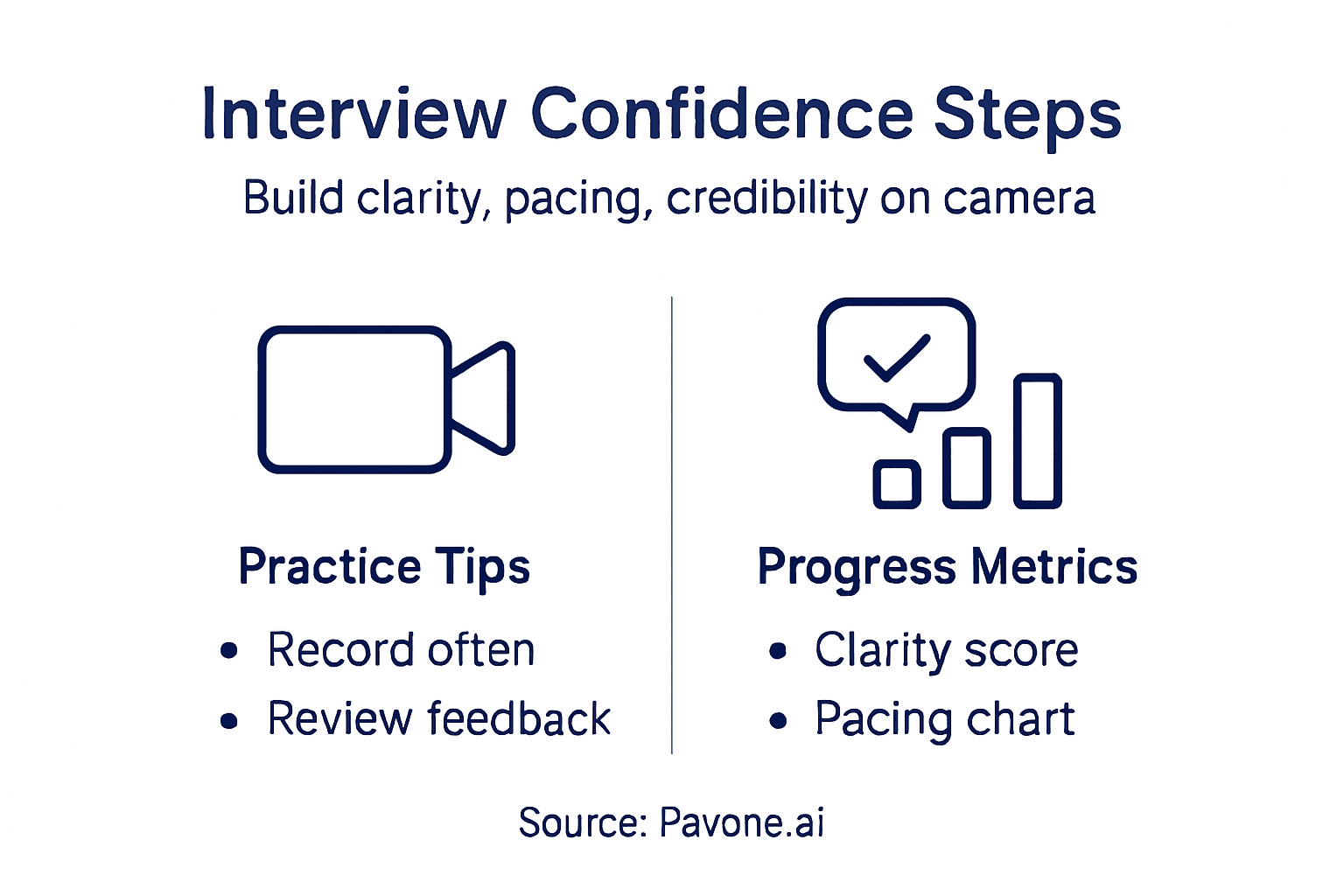
After each practice attempt, Pavone provides specific, numbered recommendations rather than vague criticism. You see exactly which sentences need restructuring, where you used fillers, and how long you paused before answering.
This specificity accelerates improvement. Instead of “improve your clarity,” you get “slow down your pace by 10 percent and replace “um” pauses with 2-second silences.” You can hear the difference immediately on your next attempt.
Most importantly, you track improvement over time. Recording the same question weekly shows measurable progress in confidence, clarity, and structure—turning abstract goals into concrete wins.
Pro tip: After reviewing feedback, re-record the same question within 24 hours while the guidance is fresh, focusing on just one metric per attempt (either pacing, fillers, or structure) rather than trying to fix everything simultaneously.
Critical factors for non-native professionals
For non-native English speakers pursuing senior tech roles, interviews present a unique challenge. Your technical competence may be exceptional, but language delivery can overshadow it if you’re not prepared. The good news: this gap is entirely trainable through targeted practice.
The core issue isn’t your English proficiency—it’s that interviews demand simultaneous technical thinking and real-time language production under pressure. Most non-native speakers haven’t rehearsed this specific combination.
The articulation and pacing challenge
Non-native speakers often struggle with clear articulation and appropriate pacing, which interviewers may misinterpret as uncertainty rather than language processing time. You might be thinking clearly but sounding hesitant.
Common patterns that undermine confidence:
- Speaking too quickly when nervous, making your accent harder to follow
- Pausing too long between thoughts, creating awkward silence
- Using filler words (“um,” “uh”) excessively to buy thinking time
- Dropping word endings or mumbling, forcing interviewers to ask you to repeat
Camera practice exposes these patterns immediately. When you watch yourself, you hear exactly how fast you’re talking and where clarity breaks down. Most non-native speakers are surprised—they sound clearer or less clear than they assumed.
Pavone’s feedback specifically highlights articulation and pace for non-native speakers, showing you exactly where to slow down and which words need clearer pronunciation.
Your accent is fine. Your pace and clarity matter. A non-native speaker who speaks slowly and clearly sounds more competent than a native speaker who rushes.
Managing cognitive load during delivery
When you’re translating mentally from your first language whilst answering a technical question, cognitive overload happens fast. Your brain is juggling three tasks: understanding the question, retrieving technical knowledge, and forming grammatically correct sentences in English.
Realistically, you cannot perform perfectly at all three simultaneously under pressure. Strategic practice helps you shift tasks to autopilot:
- Prepare structured answers for common questions so you’re not inventing language on the spot
- Practise technical vocabulary repeatedly until it becomes automatic, not retrieved
- Record yourself frequently to build muscle memory for pacing and articulation
- Slow down intentionally when explaining complex concepts, giving your brain processing time
Native speakers have the advantage of automatic language production. You build that advantage through deliberate repetition on camera.
Cultural communication norms and expectations
Direct communication styles vary globally. Some cultures value modesty and downplaying achievements; others expect confident self-promotion. Tech interviews typically reward clarity and confidence over modesty. This mismatch trips up many brilliant non-native professionals.
In your home country, you might express achievements as team efforts. In tech interviews, interviewers expect “I did X” rather than “we did X.” Owning your individual contributions sounds natural to native English speakers but uncomfortable to many non-native professionals.
Camera practice lets you rehearse communicating with interview norms—being confident without sounding arrogant, being specific about your role without dismissing teammates.
Pro tip: Record two versions of behavioural answers: one using “we” and one using “I,” then compare which sounds more confident and clear. Practise the “I” version until it feels natural, not boastful.
Common pitfalls and best practice strategies
Most candidates sabotage their interviews through predictable mistakes that camera practice quickly exposes. The good news: these pitfalls are avoidable once you know what to watch for.
The difference between a strong candidate and an average one often isn’t technical knowledge—it’s interview execution. You can know the right answer but deliver it poorly.
The preparation and research gap
Candidates frequently enter interviews without understanding the company’s technical stack, recent product launches, or team structure. This knowledge gap becomes obvious when you cannot reference company-specific examples in your answers.
Before every interview, research:
- The company’s main products and recent news or launches
- The specific team’s technical challenges and priorities
- The interviewer’s background and previous roles
- Industry trends affecting the company’s direction
When you record practice answers, deliberately include company-specific references. This trains you to weave context naturally rather than sounding generic. Interviewers immediately notice when you’ve done your homework.
Many brilliant candidates sound ordinary because their answers could apply to any company. Adding company knowledge transforms a standard answer into evidence of genuine interest.
Rushing and unclear structure
Common mistakes include poor self-pitching, lack of preparation, and failing to practise aloud before the real interview. Candidates often sprint through answers, assuming faster delivery shows confidence when it actually signals nervousness.
The core issue: you’ve rehearsed your answer silently in your head, so it feels natural. On camera, that same answer sounds rushed and unclear because you’re not accounting for your listener’s processing time.
Structural best practices:
- State your main point first (your thesis)
- Provide 2–3 supporting details with specifics
- Quantify impact where possible (metrics, timelines)
- Close with what you learnt or how it shaped your thinking
Structured answers feel slower when you deliver them, but they sound clearer to listeners. Camera practice reveals the difference between how fast you feel you’re speaking and how you actually sound.
Structure beats speed. A candidate who speaks slowly with clear organisation outperforms someone who rushes through a scattered answer.
Neglecting delivery practice
Effective interview preparation requires practising answers aloud with real or simulated audiences, not just thinking through responses mentally. Silent rehearsal creates an illusion of readiness that collapses under real-time pressure.
Delivery pitfalls that camera practice exposes:
- Filler words that distract from content (“um,” “like,” “basically”)
- Nervous habits like touching your face, fidgeting, or avoiding eye contact
- Pacing issues where you rush technical explanations or drag through simple points
- Unclear articulation that forces interviewers to ask clarifying questions
- Awkward pauses that create uncomfortable silence instead of thoughtful reflection
Most candidates are unaware of these patterns until they see themselves on camera. Silent practice never reveals them.
Below is a summary of common pitfalls and their recommended strategies for tech interview candidates:
| Pitfall | Impact on Interview | Recommended Strategy |
|---|---|---|
| Rushing answers | Reduces clarity, signals nerves | Slow down and structure response |
| Generic, non-specific answers | Fails to impress interviewers | Include company references |
| Overly scripted delivery | Sounds inauthentic | Vary your practice sessions |
| Neglecting delivery practice | Poor engagement, unclear speech | Practise on camera regularly |
Authenticity versus over-preparation
The trap: rehearsing so rigidly that your answers sound scripted rather than conversational. Interviewers detect memorised responses immediately and perceive them as inauthentic.
Balance preparation with flexibility:
- Know your key points, not word-for-word scripts
- Practise telling your story, not reciting it
- Prepare for follow-up questions, not just primary ones
- Listen actively to the interviewer’s question before launching into your answer
Camera practice trains this balance. Record multiple versions of the same answer with slightly different wording each time. You’ll find a rhythm that feels natural whilst remaining structured.
Pro tip: After practising an answer three times, step away for an hour, then record a fourth attempt without reviewing the previous versions. Compare the fourth take to the others—it often sounds most authentic because you’re not overthinking delivery.
Boost Your Interview Confidence with Pavone.ai
The article highlights how practising on camera reveals unseen communication gaps and builds clarity, pacing, and confidence for tech interviews. If you struggle to explain your thinking clearly or feel anxious about video interviews, you are not alone. Many candidates find that solving the technical problem is the easy part but conveying it persuasively is the real challenge. Pavone.ai addresses this exact need by offering a private platform to record your answers, get immediate AI-driven feedback on your delivery, and track your progress over time.
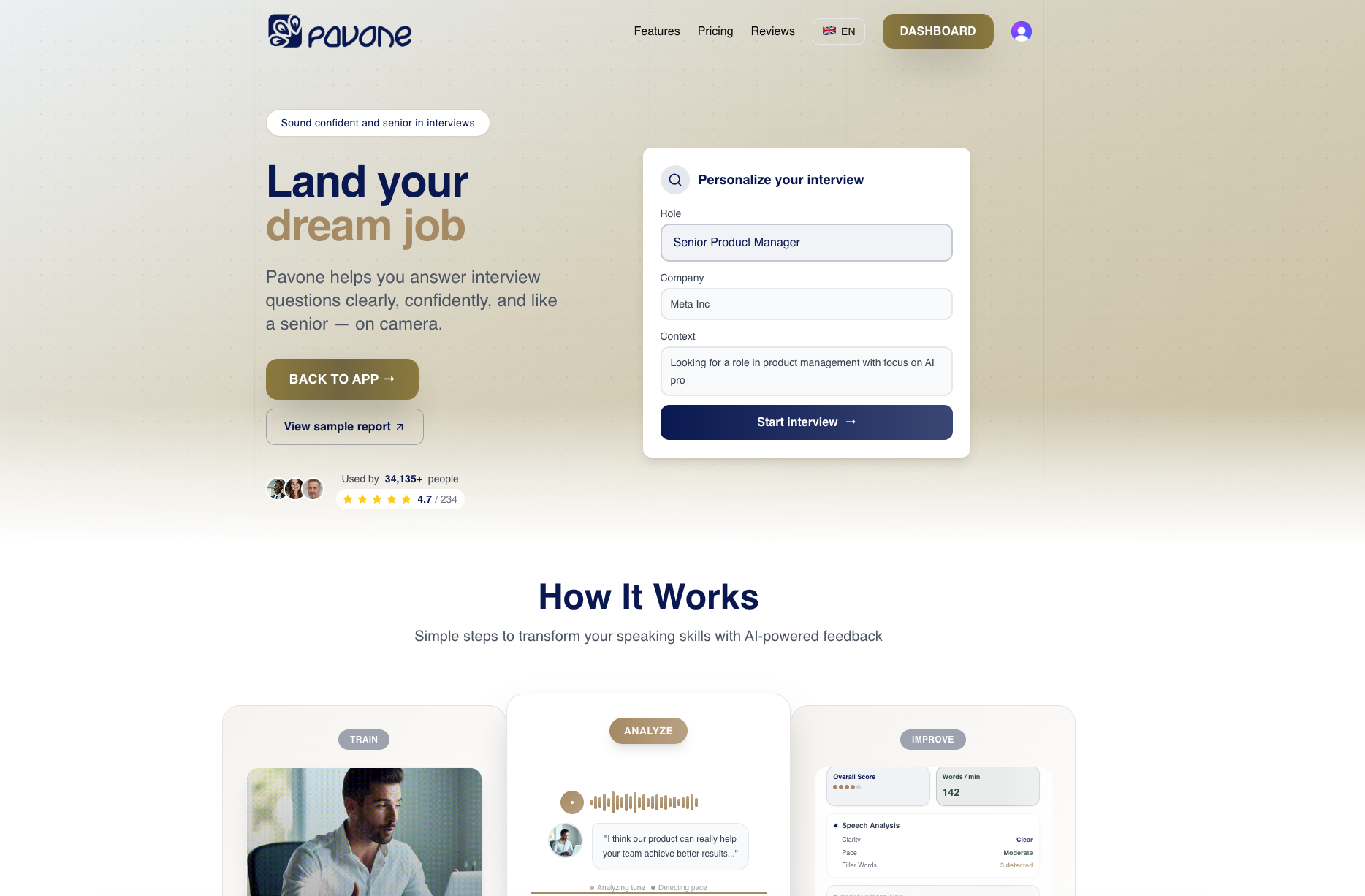
Take control of your interview performance today by practising the way tech recruiters want to hear you. Use Pavone.ai to refine your structure, reduce filler words, and speak with natural confidence. Start short, focused sessions when it suits you and watch your clarity and professionalism improve rapidly. Discover how simple repeated practice can transform your interview presence. Explore more at Pavone and take the first step towards mastering your next interview.
Try recording your answers on Pavone.ai now and experience the difference targeted camera practice makes in building confidence and communicating your strengths with impact.
Frequently Asked Questions
How can I improve my interview skills for tech roles?
Practising on camera allows you to identify communication weaknesses and technical approach weaknesses simultaneously, enhancing clarity and confidence.
Why is it important to record myself during interview practice?
Recording yourself helps to uncover blind spots in your communication, allowing you to address issues such as filler words, pacing, and clarity, which may go unnoticed otherwise.
What are the benefits of using structured versus flexible interview practice?
Structured practice builds consistency and clarity through repetition, while flexible practice enhances adaptability by simulating unpredictable interview scenarios, making you more resilient.
How can non-native English speakers prepare for tech interviews?
Non-native speakers can benefit from targeted practice to manage articulation and pacing, allowing them to communicate technical concepts clearly while reducing cognitive overload during interviews.
Recommended
Ready to practice?
Start improving your speaking skills with AI-powered feedback and analysis.
Try Pavone Free