
7 Practical Ways to Improve Speech Clarity for Presentations

Public speaking rarely feels as effortless as it looks. Whether you are presenting in front of colleagues, leading a meeting, or sharing ideas in a classroom, nerves and uncertainty can quickly undermine your confidence. Clear, confident delivery is not just about what you say but how you say it.
The right techniques make all the difference. Building strong breathing habits, improving articulation, and learning to pace yourself can transform your presence and clarity. You will also discover how to manage filler words and use pauses that help your message land with impact.
You are about to learn practical, actionable methods that take your communication skills to the next level. Small changes can lead to substantial results. Keep reading to uncover proven strategies that will help you speak with clarity and confidence.
Table of Contents
- 1. Master Breath Control for Steadier Speech
- 2. Articulate Clearly by Slowing Down Pace
- 3. Eliminate Filler Words and Unnecessary Pauses
- 4. Use Strategic Pauses to Emphasise Key Points
- 5. Project Your Voice Without Straining
- 6. Practise Active Listening to Refine Delivery
- 7. Leverage AI Feedback for Continuous Growth
Quick Summary
| Takeaway | Explanation |
|---|---|
| 1. Practice Breath Control Daily | Incorporate at least 10 minutes of breath control exercises to enhance speaking confidence and vocal stability. |
| 2. Slow Your Speaking Pace | Aim for a speaking rate of 125 to 150 words per minute for better audience comprehension and engagement. |
| 3. Eliminate Filler Words | Replace fillers like ‘um’ or ‘like’ with strategic pauses to enhance your credibility and clarity. |
| 4. Use Pauses Effectively | Implement pauses after key points to allow audience processing and to emphasize important messages. |
| 5. Leverage AI Feedback | Utilise AI analysis tools to gain precise, actionable feedback on your speech for continuous improvement. |
1. Master Breath Control for Steadier Speech
Breath control is the foundation of confident, clear public speaking. By understanding how to regulate your breathing, you can transform nervous, halting speech into a smooth, controlled delivery.
Your respiratory system plays a critical role in speech production. When you speak, breath serves as the power source for your voice, providing the necessary air pressure to create sound. Diaphragmatic breathing techniques help stabilise your vocal output, reducing tremors and uncertainty.
Practical breath control involves three key strategies. First, practice deep abdominal breathing before your presentation. This technique engages your diaphragm, creating a stable foundation for speech. Sit or stand upright, place one hand on your abdomen, and inhale slowly through your nose, feeling your stomach expand. Exhale gradually through slightly pursed lips, maintaining a steady, controlled release.
Second, synchronise your breathing with your speech. Most speakers rush their words, creating choppy, disconnected sentences. Instead, plan your breath points strategically. Take a deliberate breath at natural paragraph breaks or between key ideas. This approach allows you to speak on a controlled exhale, producing a more consistent vocal tone.
Finally, practise breath timing exercises. Record yourself speaking and analyse where your breath becomes unsteady. Identify moments of tension and practice transitioning between sentences with smooth, measured breaths. Professional speakers often use meditation and vocal warm up techniques to enhance their breath control.
Professional Advice: Practice your breath control for at least 10 minutes daily, treating it like a vocal fitness routine that builds speaking confidence gradually.
2. Articulate Clearly by Slowing Down Pace
Speed is the silent killer of clear communication. Rushing through your words might feel natural when you are nervous, but it transforms your presentation into an incomprehensible blur for your audience.
When you speak too rapidly, your listeners struggle to process information. Each word becomes muddled, key messages get lost, and your overall impact diminishes. Professional speakers understand that clarity emerges not from speed, but from deliberate, measured communication.
The science behind slower speech is fascinating. Our brains need time to decode language, connect ideas, and generate meaning. By reducing your speaking pace, you create space for your audience to absorb, reflect, and engage with your content. This approach transforms presentations from monologues into genuine conversations.
Practical implementation requires conscious effort. Start by recording yourself speaking normally, then analyse your baseline pace. Most professionals discover they speak much faster than they realise. Practice reading passages aloud, intentionally inserting strategic pauses between key phrases. Use a metronome or breathing techniques to help regulate your rhythm.
Additionally, practice articulation exercises. Tongue twisters, deliberate pronunciation drills, and vocal warm ups can dramatically improve your speech clarity. Focus on enunciating each syllable with precision, treating words like musical notes that require careful, intentional delivery.
Professional Advice: Aim to speak approximately 125 to 150 words per minute, which research indicates is the optimal pace for listener comprehension and engagement.
3. Eliminate Filler Words and Unnecessary Pauses
Filler words are the silent assassins of professional communication. Words like ‘um’, ‘like’, ‘you know’, and ‘so’ might seem harmless, but they systematically undermine your credibility and audience engagement.
Understanding why we use filler words naturally reveals their psychological function. They serve as cognitive placeholders while our brain organises thoughts, signalling to listeners that we have not finished speaking. However, excessive use transforms your presentation from polished communication to a stream of uncertain utterances.
The impact of filler words goes beyond mere annoyance. They suggest hesitation, reduce perceived confidence, and distract your audience from your core message. Imagine listening to a pitch where every third word is ‘um’ or ‘like’. Your attention would waver, and your perception of the speaker would diminish.
To eliminate these verbal stumbling blocks, start with conscious awareness. Record yourself speaking and count your filler words. Most professionals are shocked to discover they use far more than they realise. Practice replacing fillers with purposeful pauses. A strategic silence communicates thoughtfulness and control far more effectively than a string of meaningless syllables.
Develop alternative strategies for managing speech flow. When you feel a filler word approaching, take a breath. Pause. Let the silence work for you. This technique not only eliminates verbal clutter but also adds dramatic weight to your key points. Think of pauses as punctuation in spoken language, creating rhythm and emphasis.
Professional Advice: Practice your presentations in front of a mirror, focusing on replacing every potential filler word with a deliberate, confident pause.
4. Use Strategic Pauses to Emphasise Key Points
Silence speaks louder than words. In presentations, strategic pauses are not empty moments but powerful communication tools that can transform your message from ordinary to extraordinary.
Strategic pauses in speech are like punctuation marks in verbal communication. They create rhythm, build anticipation, and provide your audience critical moments to absorb complex information. Think of them as verbal white space that allows your key points to breathe and resonate.
Most speakers fear silence, rushing to fill every moment with words. This approach overwhelms listeners and dilutes your message. Professional communicators understand that pauses are not signs of weakness but deliberate techniques to command attention and emphasise important concepts.
Implementing strategic pauses requires practice and intention. After making a significant point, pause for two to three seconds. This brief silence signals to your audience that something important has just been said. It gives them time to process the information and creates a psychological emphasis that words alone cannot achieve.
Location matters when inserting pauses. Pause immediately before introducing a critical statistic, after making a profound statement, or when transitioning between key sections of your presentation. These moments of silence create intellectual tension, drawing your audience deeper into your narrative.
Professional Advice: Record yourself presenting and deliberately insert pauses, aiming to make your silences as intentional and meaningful as your spoken words.
5. Project Your Voice Without Straining
Confident speaking is not about volume but precision. Projecting your voice effectively requires understanding the delicate balance between power and control.
Voice projection techniques transform your vocal delivery from timid to commanding without risking vocal strain. The secret lies in harnessing your body’s natural respiratory system rather than forcing sound through tension and shouting.
Your diaphragm is the powerhouse of effective voice projection. Most people speak using shallow chest breathing, which limits vocal range and creates unnecessary tension. By learning diaphragmatic breathing, you engage your body’s most efficient sound production mechanism. Imagine your torso as a resonance chamber where breath becomes a controlled, powerful instrument.
To project your voice successfully, start with body alignment. Stand with your feet shoulder width apart, shoulders relaxed, and chest open. This posture creates an optimal physical foundation for sound transmission. Imagine a string pulling you upright from the crown of your head, creating length in your spine and opening your throat.
Breathing exercises are crucial for developing vocal strength. Practice inhaling deeply through your nose, allowing your abdomen to expand fully. Exhale slowly and steadily, maintaining consistent air pressure. This technique not only improves voice projection but also reduces speaking anxiety by creating a sense of physical and vocal control.
Professional Advice: Practice your vocal projection in empty rooms or outdoor spaces where you can experiment with sound without self consciousness, gradually building confidence in your natural voice.
6. Practise Active Listening to Refine Delivery
True communication is a two way conversation, not a monologue. Active listening transforms presentations from one sided lectures into dynamic, responsive interactions that captivate and engage your audience.
Most speakers talk at their audience rather than with them. Active listening skills enable you to tune into subtle verbal and nonverbal cues, adapting your delivery in real time to maintain audience connection.
Think of active listening as a form of verbal intelligence. When you genuinely tune into your audience, you gather critical feedback through their facial expressions, body language, and subtle reactions. Are they leaning forward with interest? Looking confused? Checking their phones? Each of these signals provides an opportunity to adjust your communication strategy.
Practical active listening involves multiple techniques. First, maintain eye contact with different audience members, rotating your gaze to create a sense of individual connection. Second, observe audience reactions and be prepared to pause, clarify, or elaborate based on their engagement level. Third, ask rhetorical questions that invite mental participation, transforming passive listeners into active participants.
Nonverbal communication speaks volumes. Your posture, facial expressions, and physical openness communicate just as much as your words. When you listen actively, you demonstrate respect and create a collaborative atmosphere that makes your audience more receptive to your message.
Professional Advice: Record yourself presenting and watch the playback, focusing on moments where you could have paused, adjusted tone, or responded to audience energy more dynamically.
7. Leverage AI Feedback for Continuous Growth
Technology has transformed learning, and artificial intelligence now offers unprecedented insights into communication skills. Your presentation prowess can dramatically improve through intelligent, objective analysis.
AI feedback systems provide nuanced, personalised assessments that human coaches might miss. Unlike traditional feedback methods, AI can analyse multiple speech dimensions simultaneously: vocal tone, pace, clarity, body language, and linguistic precision.
Imagine having a digital coach that tracks your speaking performance with microscopic detail. Modern AI tools can detect subtle communication patterns invisible to the human ear. They measure speech rhythm, identify filler word frequency, evaluate pronunciation clarity, and even assess emotional engagement through vocal modulation.
Practical implementation requires an open mindset. Record your presentations using AI analysis platforms. Review comprehensive reports that break down your performance into actionable insights. Pay special attention to recurring patterns like unnecessary pauses, speaking speed variations, and moments of reduced clarity.
Consistent practice is key. Treat AI feedback as a personalised training programme. Each analysis provides a roadmap for improvement, highlighting strengths and pinpointing areas requiring focused development. Regular review and iterative practice transform these insights into tangible communication skills.
Professional Advice: Approach AI feedback as a collaborative learning experience, viewing each analysis not as criticism but as a precise, objective guide to communication mastery.
Below is a comprehensive table summarising the key strategies and practices for improving public speaking as discussed in the provided article.
| Topic | Description | Recommended Practices |
|---|---|---|
| Breath Control | An essential foundation for clear speech; involves managing breathing to stabilise vocal delivery. | Practise diaphragmatic breathing, synchronise breathing with speech, and utilise timing exercises. |
| Articulation Clarity | Slowing down speaking pace improves listener comprehension. | Analyse speaking baseline pace, practise deliberate pronunciation, and focus on intentional delivery with strategic pauses. |
| Eliminating Filler Words | Filler words diminish the impact of communication by suggesting hesitation. | Record and analyse speech, replace fillers with pauses, and practise deliberate silence during presentations. |
| Strategic Pausing | Using pauses effectively enhances message emphasis and audience engagement. | Insert pauses before key points and transitions, creating moments of reflection for listeners. |
| Vocal Projection | Effective voice projection comes from efficient breathing and posture, not sheer loudness. | Stand with upright posture, utilise diaphragmatic breaths, and practise consistent air pressure during exhalation. |
| Active Listening | Understanding audience reactions fosters dynamic and engaging communication. | Maintain eye contact, observe nonverbal feedback, and adjust presentation style responsively. |
| Leveraging AI Feedback | AI tools provide detailed insights to refine communication skills continuously. | Use AI platforms to receive reports on pace, clarity, and tone, and follow tailored improvement plans based on identified patterns. |
This table encapsulates the guidance and techniques shared in the article, aiming to enhance public speaking skills for both clarity and impact.
Take Control of Your Speech Clarity with Pavone.ai
Struggling with filler words, pacing, or projecting your voice clearly as described in “7 Practical Ways to Improve Speech Clarity for Presentations” can leave you feeling frustrated and unheard. Whether it is mastering breath control or eliminating unnecessary pauses, these challenges require precise, actionable feedback tailored to your unique speaking style. Pavone.ai offers an AI-driven solution that listens carefully to every presentation, conversation, or speech you record and provides immediate insights to help you improve clarity, tone, and confidence.
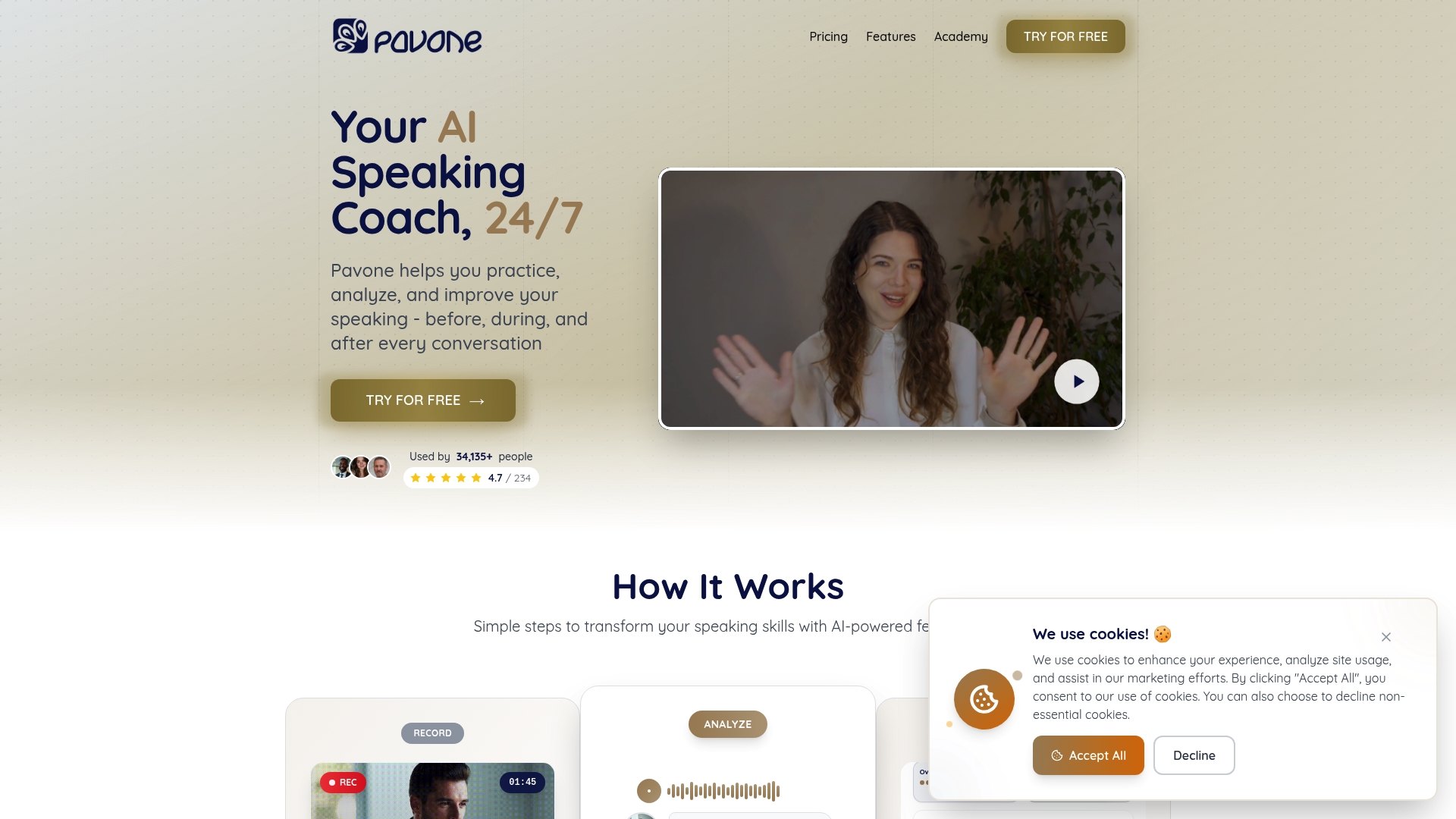
Experience how Pavone.ai transforms nervous or unclear speech into compelling and confident communication through personalised analytics and easy-to-follow guidance. Start your journey towards becoming a more articulate presenter today by visiting Pavone.ai. Take advantage of this innovative personal coaching tool and discover how consistent practice combined with intelligent feedback can finally bring your public speaking skills to the next level.
Frequently Asked Questions
How can I improve my breath control for clearer speech?
To enhance breath control, practice deep abdominal breathing regularly. Dedicate at least 10 minutes each day to exercise your diaphragm, which can significantly steady your vocal output and reduce nervousness in your delivery.
What are effective strategies to reduce filler words during presentations?
To eliminate filler words like ‘um’ and ‘like’, start by recording your practice sessions. Consciously replace each filler with a purposeful pause, allowing you to communicate more confidently and clearly, which can drastically improve your audience’s perception of your message.
How do I use pauses effectively to emphasise key points?
Incorporate strategic pauses after key statements to give your audience time to absorb important information. Aim for 2 to 3 seconds of silence after making a significant point, as this reinforces your message and encourages reflection.
What is the ideal speaking pace for presentations?
For optimal clarity and engagement, strive to speak at a pace of 125 to 150 words per minute. Monitor your speed during practice and consciously slow down, allowing your audience to process your content better.
How can I effectively project my voice without straining?
To project your voice confidently, practice diaphragmatic breathing rather than relying on shallow chest breathing. Stand upright, with relaxed shoulders, and focus on maintaining consistent air pressure as you speak, ensuring your voice is clear and strong without any strain.
How can active listening improve my presentation delivery?
Practising active listening helps you engage with your audience more effectively by tuning in to their reactions. Maintain eye contact and observe their nonverbal cues, adjusting your delivery accordingly to foster a more interactive and responsive atmosphere during your presentation.
Recommended
Ready to practice?
Start improving your speaking skills with AI-powered feedback and analysis.
Try Pavone Free