
Body Language in Interviews: Boosting Tech Careers

Stepping into your first interview at a thriving London startup or a leading Canadian tech firm, the nerves can feel overwhelming. For new graduates, mastering non-verbal communication is just as crucial as knowing Python or Java, since hiring managers often judge suitability within seconds based on body language. Whether you’re interviewing in Manchester, Berlin, or Silicon Valley, understanding what your posture, facial expression, and eye contact say about you will help shape a lasting impression during those pivotal first moments.
Table of Contents
- Defining Body Language In Interviews
- Non-Verbal Signals And Their Meanings
- First Impressions And Impact On Hiring
- Common Mistakes In Interview Body Language
- Adapting Body Language For Tech Roles
- Improving Body Language Using Analytics
Key Takeaways
| Point | Details |
|---|---|
| Body Language Matters | Non-verbal signals such as posture, eye contact, and gestures significantly influence interviewers’ perceptions and decisions. |
| Cultural Awareness is Crucial | Understanding cultural differences in body language can enhance communication and build rapport in diverse interview settings. |
| First Impressions Count | Hiring managers form initial judgements within seconds; thus, presenting confident and open body language is essential for making a positive impact. |
| Self-Analysis for Improvement | Recording and reviewing your interview responses with a focus on body language can help identify areas for improvement and build confidence. |
Defining body language in interviews
Body language is far more than just how you sit or stand during an interview. It encompasses the entire spectrum of non-verbal communication, including facial expressions, hand gestures, posture, eye contact, and spatial positioning. When you walk into that conference room or join a video call, you’re sending signals before you speak a single word.
In tech interviews specifically, your body language communicates confidence, engagement, and professionalism alongside your technical knowledge. Recruiters and hiring managers form impressions within seconds, and those first impressions are heavily influenced by what your body conveys. Whether you’re interviewing at a startup or a multinational tech company, the fundamentals remain consistent.
Non-verbal communication involves spatial distance, eye gaze, posture movements, and facial expressions that collectively express your emotions and intentions during conversations. Think of your body language as the supporting cast to your words. If your words say “I’m excited about this opportunity” but your shoulders are hunched and you’re avoiding eye contact, the interviewer will trust your body more than your words.
Cultural context matters too. What reads as confident in one culture might come across as aggressive in another. A professional distance that works in North America might feel distant in Southern Europe. As a tech professional, you’ll likely interview with people from diverse backgrounds, so awareness of these nuances gives you an advantage.
The real power lies in integration. Your verbal communication, vocal delivery, and body language must work together harmoniously. When they align, you create credibility. When they conflict, you create doubt.
Pro tip Record yourself answering common tech interview questions, then review your body language separately from your answers. Most new graduates are shocked at what they discover about their fidgeting, facial expressions, or posture when seeing themselves on video.
Non-verbal signals and their meanings
Every gesture, every glance, every shift in your posture carries meaning. During an interview, your non-verbal signals are constantly being interpreted, whether consciously or unconsciously. Understanding what each signal communicates is the first step toward controlling your narrative.
Facial expressions, posture, hand movements, and gaze direction communicate qualities like confidence, interest, and professionalism. A genuine smile signals openness. A furrowed brow suggests confusion or concern. Maintained eye contact demonstrates engagement, whilst looking away repeatedly signals nervousness or disinterest. These micro expressions happen in milliseconds, but they register instantly with the person across from you.
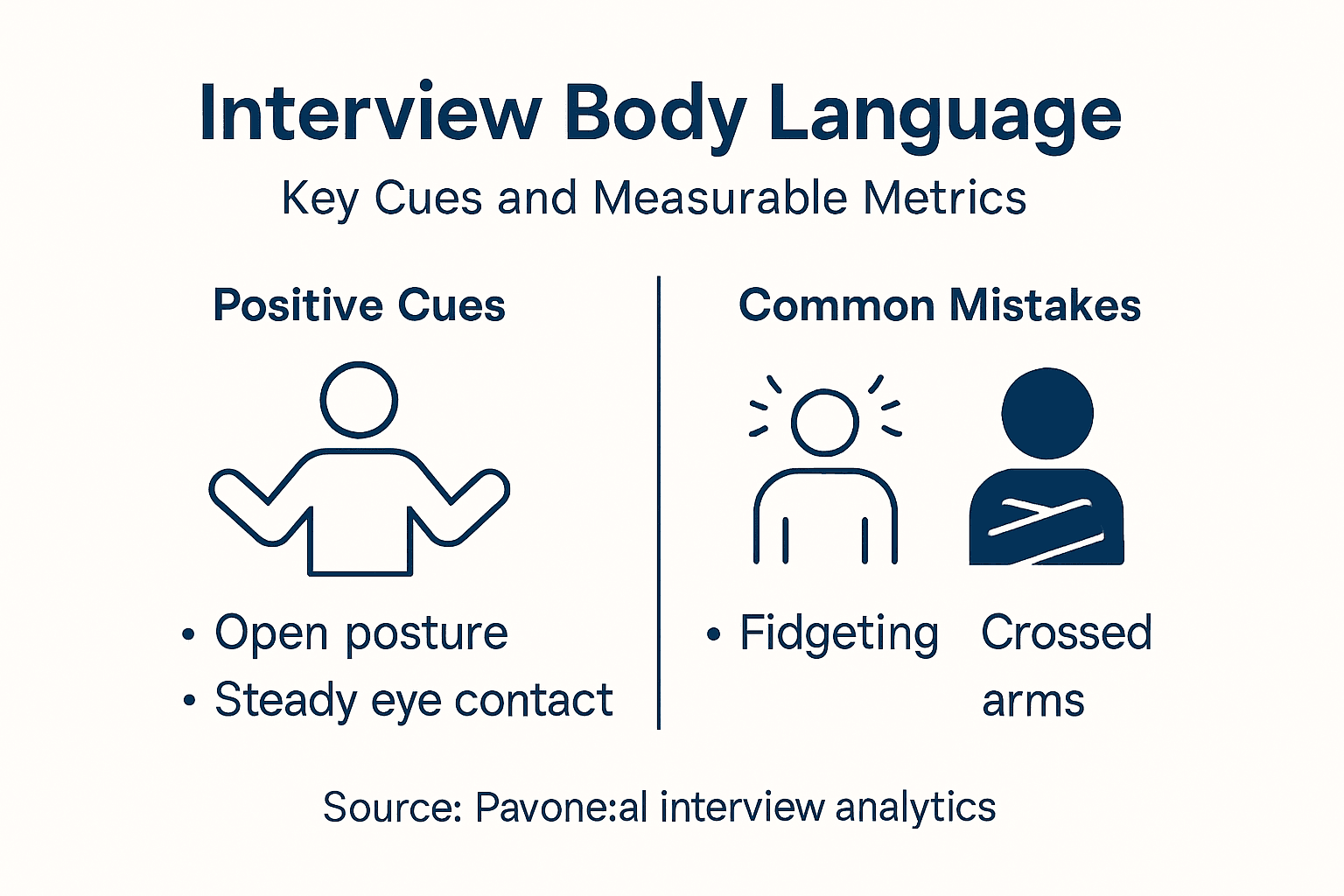
Your hands tell their own story. Steady, purposeful gestures reinforce your words and show confidence. Fidgeting—twisting a pen, picking at your sleeve, tapping your fingers—broadcasts anxiety. Open hand movements, palms facing upwards or outwards, convey honesty and openness. Crossed arms or closed hand positions can appear defensive, even if that’s not your intention.
Posture is perhaps the most overlooked signal. Slouching communicates lack of interest or low energy. Leaning forward slightly shows engagement and enthusiasm. Sitting upright with relaxed shoulders projects competence without appearing rigid. In video interviews, positioning matters too; sitting too close to the camera feels invasive, whilst sitting too far appears distant.
Proxemics—the space between you and the interviewer—matters more than most people realise. Too close feels uncomfortable; too far suggests lack of connection. Professional distance typically ranges between 60 and 90 centimetres in Western contexts, though this varies culturally.
The crucial insight: non-verbal signals shape perceptions about credibility, confidence, and professionalism. Your words can say one thing, but your body language ultimately determines whether the interviewer believes you.
Pro tip Before your interview, do a quick video self-check using your phone camera. Record yourself answering one question, then watch it back with the sound off. This reveals exactly what your body language is communicating without distraction from your words.
Here’s a summary of key body language signals and their typical interview impact:
| Signal Type | Positive Effect | Negative Effect |
|---|---|---|
| Eye contact | Shows engagement and confidence | Suggests anxiety or dishonesty |
| Posture | Projects professionalism | Implies disinterest or low energy |
| Hand gestures | Reinforces communication | Signals nervousness or distraction |
| Facial expressions | Indicates authenticity | Appears cold or confused |
| Proxemics (space) | Builds comfort and trust | Feels invasive or disconnected |
First impressions and impact on hiring
You have roughly seven seconds. That’s the window in which hiring managers form their initial judgement about you. Before you’ve answered a single technical question, before you’ve discussed your experience or your passion for coding, your body language has already communicated volumes.
Evaluators form judgements in seconds, often based on body language and facial expressions, which strongly affect interview outcomes. This isn’t unfair or shallow; it’s how human brains work. Your interviewer is wired to make rapid assessments based on visual information. The key is ensuring your body language sends the right message during those critical opening moments.
In tech specifically, first impressions carry extra weight. Hiring managers are evaluating not just whether you can do the job, but whether you’d fit the team culture. They’re wondering if you’ll communicate effectively in standups, pair programming sessions, and code reviews. Your body language answers these questions before your mouth does.
Nonverbal facial behaviours like smiling and eye contact influence how likeable and suitable candidates appear to employers. A warm smile when you enter the room immediately puts the interviewer at ease. Genuine eye contact signals honesty and engagement. These aren’t manipulative tactics; they’re simply how you demonstrate authenticity.
What makes this particularly significant for new graduates is that body language often outweighs inexperience. A junior developer who projects confidence, engagement, and professionalism will be remembered far more positively than a technically stronger candidate who appears anxious or disinterested. Hiring managers know they’ll need to invest in training; what they’re assessing is your coachability and presence.
The compounding effect matters too. These early impressions shape how your interviewer interprets everything that follows. If you start strong, they’ll give your answers more charitable interpretations. If you start weak, they’ll scrutinise your responses more critically.
Pro tip Arrive 10 minutes early and spend those minutes in a quiet space doing box breathing (inhale for 4, hold for 4, exhale for 4). This settles your nervous system and allows you to walk in naturally composed, so your body language reflects genuine confidence rather than controlled anxiety.
Common mistakes in interview body language
Most interview body language mistakes aren’t intentional. You’re nervous, you’re focused on your answers, and your body does what it naturally does under stress. The problem is that these unconscious behaviours communicate things you absolutely don’t want to say.
A weak handshake tops the list of avoidable errors. It takes three seconds and creates a lasting negative impression. Interviewers notice immediately whether your grip is firm, limp, or somewhere in between. A confident handshake signals competence; a weak one suggests you lack confidence or engagement.

Then there’s the posture problem. Slouching communicates disinterest, fatigue, or low confidence, even if you’re genuinely excited about the role. Leaning back excessively can appear arrogant or dismissive. The sweet spot is upright but relaxed, which projects both professionalism and approachability.
Avoiding eye contact, crossed arms, and excessive fidgeting negatively impact hiring managers’ perceptions in interviews. Each of these behaviours signals something problematic. Avoiding eye contact suggests dishonesty or anxiety. Crossed arms appear defensive. Fidgeting broadcasts nervousness. Yet many candidates do all three simultaneously without realising it.
Facial expressions matter more than most people realise. A pursed mouth, furrowed brow, or completely neutral expression can make you appear uninterested, confused, or cold. Your face should reflect genuine engagement with the conversation. This doesn’t mean smiling constantly; it means letting your natural interest show.
Over-gesturing creates the opposite problem. Wild hand movements distract from your words and can make you appear anxious or inauthentic. Your gestures should reinforce what you’re saying, not compete with it. When controlling these behaviours, you prevent conflicting body language from betraying your true abilities, regardless of how strong your verbal performance is.
Pro tip Film yourself answering interview questions and play it back on mute. Without hearing your words, you’ll spot fidgeting, slouching, limited eye contact, and excessive hand movements that you’d otherwise miss during live practice.
Adapting body language for tech roles
Tech interviews aren’t the same as interviews in other fields. The culture is different, the expectations are different, and your body language needs to reflect that reality. What works in finance or law might feel out of place in a startup engineering team.
Tech culture values authenticity and approachability. This doesn’t mean you should slouch or dress casually for an interview, but it does mean your body language should feel natural rather than overly formal. You’re not trying to project commanding authority like a CEO; you’re trying to signal that you’re genuinely interested in solving problems and working collaboratively.
There’s a particular balance in tech. You need confidence without arrogance. Engagement without nervousness. Professionalism without stiffness. This is where controlled gestures, open posture, and deliberate eye contact support clearer communication of your technical knowledge and ideas.
For technical discussions specifically, your gestures should help explain complex concepts. When you’re describing system architecture or walking through code logic, purposeful hand movements clarify your thinking. But these gestures should feel organic to what you’re explaining, not performed for effect.
Maintaining eye contact, using open postures, and purposeful gestures help establish authority and build trust in technical environments. This matters regardless of your background, but it’s particularly important if you’re underrepresented in tech. Your body language directly impacts how your technical capabilities are perceived.
One tech specific consideration is video interviews, which are now standard. The camera changes everything. What feels natural in person can look manic on screen, whilst sitting too still appears disengaged. Your positioning, distance from the camera, and eye contact with the lens (not the screen) all matter.
Pro tip During video interview practice, position the camera at eye level and imagine the interviewer is living inside the camera lens. This helps you maintain genuine eye contact, which translates to connection and confidence on the other end.
To help you tailor your body language for tech interviews, compare these approaches:
| Context | Recommended Approach | Avoid These Behaviours |
|---|---|---|
| In-person interview | Open posture, firm handshake | Slouching, limp grip |
| Video interview | Eye-level camera, measured gestures | Looking away, wild movements |
| Technical discussion | Purposeful gestures, relaxed shoulders | Over-explaining with hands |
Improving body language using analytics
Self awareness is the foundation of change. Most people can’t accurately assess their own body language. You think you’re making eye contact when you’re actually looking at the wall. You believe your posture is confident when you’re actually slouching. This disconnect between perception and reality is where analytics become invaluable.
Modern technology has made it possible to analyse body language objectively. Rather than relying on vague feedback or your own unreliable self assessment, you can now get precise data about what your body is actually communicating. AI powered systems analyse facial expressions, gestures, posture, and eye contact via computer vision and machine learning, generating personalised feedback to improve your interview performance.
The power lies in the specificity. Instead of hearing “you fidget too much,” you’ll learn exactly when you fidget, for how long, and what triggers the behaviour. Instead of “maintain more eye contact,” you’ll see data showing your eye contact duration compared to optimal benchmarks. This precision transforms vague advice into actionable targets.
Biometric analysis of posture, gestures, and facial expressions helps users reflect and enhance their communication effectiveness. Recording yourself answering interview questions and reviewing the analytics reveals patterns you’d otherwise miss. You can see your confidence levels spike or drop at specific moments, correlate your hand movements with your verbal hesitations, and track improvements across multiple practice sessions.
The data also removes emotion from self-critique. Watching yourself on video is painful and often triggers harsh self judgment. Analytics reframe this as neutral information to work with. You’re not “bad at interviews”; your eye contact duration is 2.3 seconds when optimal is 4 to 5 seconds. That’s fixable.
Progress becomes measurable too. When you can see your eye contact duration improve from session one to session five, motivation increases. You’re no longer relying on hope; you’re watching concrete improvement happen.
Pro tip Record three separate practice interviews and track one specific metric across all three (eye contact duration, fidget frequency, or gesture count). Seeing measurable improvement over just three attempts proves the technique works and builds confidence before your actual interview.
Master Your Interview Body Language with AI-Powered Insights
Feeling uncertain about how your non-verbal cues come across during tech interviews? The article highlights critical challenges like aligning eye contact, posture, and gestures to boost confidence and credibility. Many candidates struggle with unconscious habits such as fidgeting or slouching that can undermine their presence. The goal is clear: to create authentic, engaging body language that resonates with interviewers within those crucial first seven seconds.
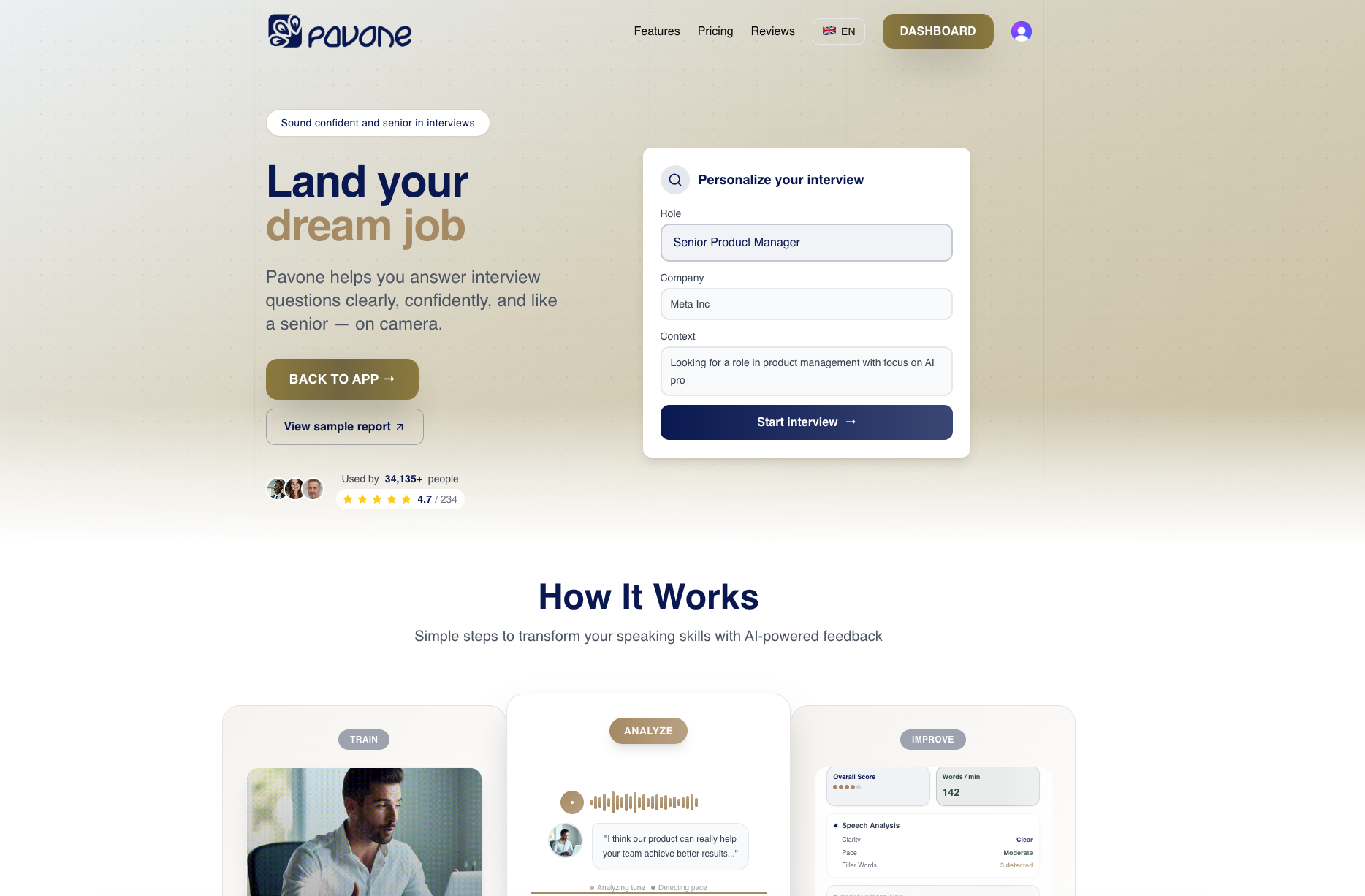
Take control of your interview impression by using Pavone.ai, an easy-to-use platform that provides AI-driven analytics on your body language and vocal delivery. Record your practice interviews and receive detailed feedback on eye contact duration, posture, and hand movements to identify weak spots and track improvement. Empower yourself to communicate with genuine confidence and professionalism tailored for tech careers. Start refining your skills today with Pavone.ai and experience the transformation before your next opportunity. Visit https://pavone.ai to begin your journey now.
Frequently Asked Questions
What is the importance of body language in interviews?
Body language in interviews is crucial as it communicates confidence, engagement, and professionalism. It can influence first impressions and shape how interviewers perceive your credibility and suitability for the role.
How can I improve my body language for tech interviews?
To improve your body language for tech interviews, focus on maintaining good posture, making steady eye contact, and using purposeful hand gestures that reinforce your communication. Practicing in front of a camera can also help identify and correct any negative habits.
What are common body language mistakes to avoid during an interview?
Common body language mistakes include having a weak handshake, slouching, avoiding eye contact, crossing your arms, and excessive fidgeting. These behaviours can signal disinterest or anxiety, negatively impacting the interviewer’s perception.
How does non-verbal communication differ in a tech interview compared to other fields?
In tech interviews, the focus is on authenticity and approachability rather than commanding authority. Candidates should project confidence without coming across as arrogant and engage openly to signal their interest in collaborative problem-solving.
Recommended
- How to Speak Confidently in Job Interviews - Pavone
- Academy - Public Speaking & Communication Tips | Pavone
- Ace Your Job Interview - AI Interview Practice | Pavone
- Speak Confidently in Meetings - Pavone Academy
- Understanding Effective Virtual Team Tips for Success – Optio Station: Best Project Management App for Prioritization
- From Classroom to Career: Student Success Strategies that Work
Ready to practice?
Start improving your speaking skills with AI-powered feedback and analysis.
Try Pavone Free