
Ace Amazon interviews: key questions and proven strategies

TL;DR:
- Amazon’s interview process is structured around 16 Leadership Principles, making questions deliberate and predictable.
- Behavioral questions focus on real experiences using the STAR method, tied directly to Leadership Principles.
- Technical rounds for senior roles involve coding and system design, emphasizing problem-solving, clear communication, and trade-offs.
Amazon interviews have a reputation for being unpredictable and brutally difficult. That reputation is largely undeserved. The truth is, Amazon’s process is structured around 16 Leadership Principles, and once you understand how those principles shape every question you’ll face, the whole thing becomes far more navigable. This guide walks you through the interview format, the most common questions, how technical rounds work, and the smartest ways to practise. By the end, you’ll have a clear mental roadmap for walking into your Amazon interview with confidence rather than dread.
Table of Contents
- How Amazon structures its interview questions
- Amazon’s core behavioural questions: What to expect
- Tackling technical interviews: Code, design and the ‘bar raiser’
- How to practise and get feedback for Amazon interviews
- A fresh take: What most guides miss about Amazon interview preparation
- Take your Amazon interview prep to the next level
- Frequently asked questions
Key Takeaways
| Point | Details |
|---|---|
| Amazon interviews are predictable | Knowing the structure and question types removes surprises and calms nerves. |
| STAR stories get results | Using the Situation, Task, Action, Result framework helps convey achievements clearly. |
| Practice under pressure | Mock interviews and feedback build real confidence for live Amazon interviews. |
| Bar raiser standards are unique | You need to exceed expectations, not just meet them, for a successful offer. |
| Be authentic and adaptable | Candid, flexible answers appeal more to Amazon interviewers than rehearsed responses. |
How Amazon structures its interview questions
Now that you know there’s a method behind the process, let’s detail what Amazon really asks and why.
Amazon’s hiring process typically moves through three stages: an online assessment, one or two phone screens, and a final interview loop. The loop usually involves four to seven back-to-back interviews conducted on the same day, either virtually or on-site. Each interviewer is assigned two or three Leadership Principles to probe, which means the questions you face are deliberate and pre-planned, not spontaneous.
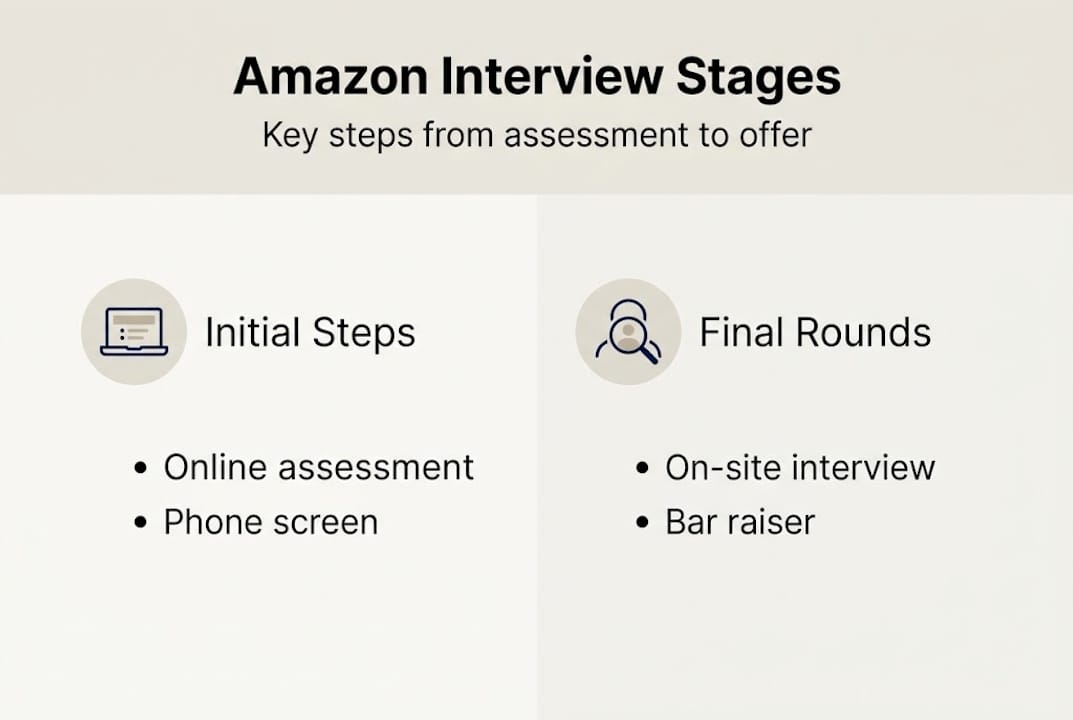
One of the most distinctive features of Amazon’s process is the bar raiser. This is a specially trained interviewer, independent of the hiring team, whose job is to maintain Amazon’s hiring standards. The bar raiser has veto power and is specifically looking for whether you’d raise the overall quality of the team, not just fill a seat.
Here’s what each stage typically covers:
- Online assessment: Logical reasoning, work style questionnaires, and sometimes a coding challenge depending on the role
- Phone screen: A mix of behavioural questions and, for technical roles, a light coding exercise
- Interview loop: Deep behavioural questions mapped to Leadership Principles, plus technical rounds for mid-senior roles covering coding and system design
The format for behavioural questions is always STAR: Situation, Task, Action, Result. Every interviewer assesses 2-3 specific Leadership Principles using this method. That means your answers need a clear beginning (the context), a defined problem (your responsibility), a specific set of actions you personally took, and a measurable outcome.
“The STAR method isn’t just a nice framework. At Amazon, it’s the lens every interviewer uses to evaluate whether your experience is real and relevant.”
For mid-to-senior roles, you’ll also face technical rounds. Coding interviews typically involve algorithm and data structure problems at a medium-to-hard difficulty level. System design rounds ask you to architect scalable solutions, discuss trade-offs, and clarify scope. Both rounds reward clear thinking as much as correct answers. Practise building your responses with a STAR method answer builder to sharpen your structure before the real thing.
| Interview stage | Format | What’s assessed |
|---|---|---|
| Online assessment | MCQ, coding, work style | Baseline skills, reasoning |
| Phone screen | Behavioural + light coding | Communication, technical basics |
| Loop: behavioural | STAR-based questions | Leadership Principles |
| Loop: technical | Coding + system design | Problem solving, architecture |
| Bar raiser round | Deep follow-ups | Overall bar vs. current team |
Amazon’s core behavioural questions: What to expect
With the interview’s backbone clear, here’s how to handle the behavioural side Amazon prizes.

Behavioural questions at Amazon are not random. They are directly tied to the 16 Leadership Principles, and interviewers are trained to probe each one thoroughly. Amazon focuses on past behaviour, not hypothetical scenarios, so every answer you give must be grounded in a real experience.
Here are some of the most frequently asked questions and the principles they target:
| Question | Leadership Principle targeted |
|---|---|
| Tell me about a time you disagreed with a decision | Have Backbone; Disagree and Commit |
| Describe a situation where you took ownership | Ownership |
| Give an example of a time you used data to make a decision | Are Right, A Lot |
| Tell me about a time you failed | Learn and Be Curious |
| Describe a project where you had to influence without authority | Earn Trust |
The most common traps candidates fall into are vagueness, overgeneralising, and missing measurable results. Saying “we improved the process” is weak. Saying “I reduced deployment time by 40% over three months by introducing automated testing” is what Amazon wants to hear.
When structuring your stories, aim for this:
- Situation: Keep it brief. One or two sentences to set the scene.
- Task: Be specific about your role and what was at stake.
- Action: Use “I,” not “we.” Amazon wants to know what you did.
- Result: Quantify wherever possible. Numbers, percentages, and timelines matter.
Pro Tip: Prepare at least two strong stories for each Leadership Principle. Interviewers often ask follow-up questions that require a different example, so having depth in your story bank protects you from being caught out.
Practise these responses out loud with mock Amazon interview practice to build fluency and reduce the tendency to ramble under pressure.
Tackling technical interviews: Code, design and the ‘bar raiser’
Once you’ve mastered the behavioural approach, it’s time to tackle Amazon’s demanding technical rounds.
For mid-to-senior roles, technical interviews are a significant part of the loop. Coding rounds typically involve two to three problems drawn from data structures and algorithms. Think arrays, trees, graphs, dynamic programming, and sorting. The expectation is not just a working solution but an optimal one, with clear reasoning about time and space complexity.
System design rounds are particularly important for senior roles. You’ll be asked to design something like a URL shortener, a distributed cache, or a notification service. The interviewer wants to see how you:
- Clarify requirements before jumping in
- Break the problem into components
- Discuss trade-offs between different architectural choices
- Identify bottlenecks and propose solutions
- Communicate your thinking clearly throughout
That last point is critical. Amazon values candidates who think out loud. Silence is rarely your friend in a technical round.
“The bar raiser is not there to trick you. They’re there to assess whether you’d raise the quality of the team. That means depth, not just correctness.”
Bar raiser interviewers focus on raising the bar compared to Amazon’s average, and crucially, no brain teasers are used. Every question is grounded in real skills and genuine problem-solving ability. The bar raiser will often ask deep follow-ups to test whether you truly understand your own solutions or are simply pattern-matching from memorised answers.
Pro Tip: Before your technical round, practise explaining your solutions to someone who isn’t technical. If you can make your reasoning clear to them, you’ll have no trouble articulating it to an interviewer. Use Amazon online interview practice to simulate the pressure of talking through problems on camera.
Best practices for technical rounds:
- Always restate the problem in your own words before coding
- Ask clarifying questions about edge cases and constraints
- Walk through your approach before writing a single line of code
- Justify your data structure choices explicitly
- Test your solution with examples, including edge cases
How to practise and get feedback for Amazon interviews
Knowing the questions is half the battle; smart practice sets you apart.
The most effective preparation mimics the real conditions of an Amazon interview. That means timed responses, camera on, and no notes. Practising under real interview conditions significantly improves STAR answer quality, technical clarity, and your ability to manage pressure in the moment.
Here’s a practical preparation framework:
- Build your story bank: Write out STAR stories for all 16 Leadership Principles. Aim for two stories per principle. Review them regularly but don’t memorise them word-for-word.
- Record yourself: Watch your recordings critically. Look for filler words, lack of structure, or answers that drift away from the question.
- Simulate the loop: Practice four to five back-to-back questions without breaks. Amazon loops are exhausting, and stamina matters.
- Seek specific feedback: Generic feedback like “that was good” won’t help you improve. Ask for feedback on structure, specificity, and whether your result was compelling.
- Use question generators: Role-specific question generators help you practise scenarios relevant to your level and function.
Pro Tip: After recording a practice answer, transcribe it and read it back. Gaps in logic and vague language become far more obvious on paper than they do when you’re listening to yourself speak.
The goal is not to have perfect, polished answers. It’s to have clear, honest, well-structured ones that you can adapt when the interviewer pushes back or asks for a different angle. Use online interview practice tools to get structured feedback on delivery, and pair that with a STAR method builder to tighten your content before each session.
A fresh take: What most guides miss about Amazon interview preparation
After all the best practices, here’s what really matters from an insider’s perspective.
Most preparation guides focus on what to say. The bigger risk, in our experience, is candidates who over-prepare polished stories that sound rehearsed. Interviewers at Amazon are skilled at detecting when someone is reciting a script rather than recalling a real experience. The tell-tale signs are suspiciously round numbers, overly tidy narratives, and an inability to answer natural follow-up questions.
The candidates who stand out are the ones willing to show genuine complexity. That means talking about decisions that had real trade-offs, mistakes that were genuinely costly, and growth that required uncomfortable self-reflection. Saying “I made the wrong call and here’s what I learned” is far more compelling than a flawless success story.
Self-assessment is the skill most candidates underinvest in. Before your interview, spend time honestly reviewing your own work history. What did you actually own? Where did you fall short? What would you do differently? Those answers, delivered with clarity and confidence, are what win offers at Amazon. Pair that reflection with answering top interview questions to sharpen how you communicate under pressure.
Take your Amazon interview prep to the next level
For those ready to put knowledge into action, there are excellent tools designed for Amazon interview success.
Pavone.ai gives you a private space to record your answers on camera and receive immediate, actionable feedback on clarity, structure, pacing, and confidence. It’s the closest thing to a personal interview coach available at any hour.
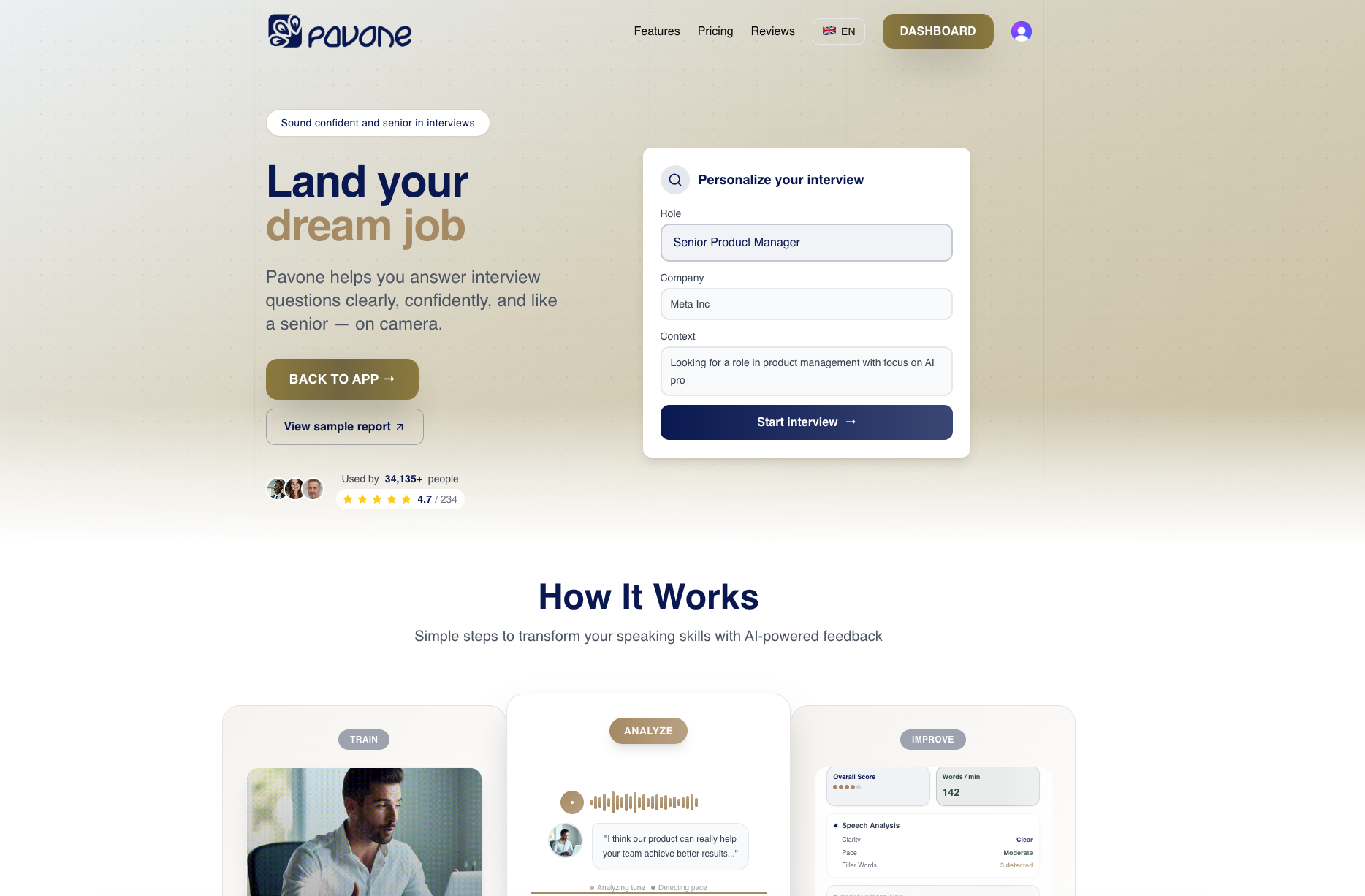
Start with the free interview question generator to build a tailored question bank for your specific role. Then work through the Amazon interview practice course to simulate real loop conditions, sharpen your STAR delivery, and track your improvement over time. The feedback is specific, the practice is realistic, and the results speak for themselves.
Frequently asked questions
What are the most common questions in an Amazon interview?
Amazon interviews heavily emphasise behavioural questions based on the 16 Leadership Principles, alongside technical scenarios relevant to the role. Every question is designed to reveal how you think and act in real situations.
How does the bar raiser affect Amazon interview outcomes?
The bar raiser holds significant influence and can block a hire if they feel the candidate doesn’t clearly raise the bar compared to Amazon’s existing team. Their focus is on depth of thinking, not just correct answers.
What’s the best way to prepare for Amazon behavioural interviews?
Prepare strong STAR stories linked to specific Leadership Principles and practise them under realistic conditions. The STAR method is recommended for every answer, so structure and specificity are non-negotiable.
Are brain teasers or trick questions used at Amazon?
No brain teasers are used at Amazon. All questions focus on real experiences, problem solving, and genuine skills relevant to the role.
What technical skills are tested for mid-senior roles at Amazon?
You’ll be assessed on coding across data structures and algorithms, plus system design for senior roles. Technical interviews cover coding at a medium-to-hard level and expect clear communication of trade-offs throughout.
Recommended
Ready to practice?
Start improving your speaking skills with AI-powered feedback and analysis.
Try Pavone Free