
Excel at Apple interview questions in 2026: video tips

TL;DR:
- Apple’s interview process combines technical, behavioral, and video communication skills, with higher expectations for senior roles.
- Clear explanation, trade-off analysis, and collaborative problem-solving are essential during all interview stages.
- Practicing frameworks, authentic dialogue, and technical setup improves confidence and performance on camera.
Landing a role at Apple is genuinely difficult. The interview process in 2026 is more demanding than ever, combining deep technical scrutiny with behavioural nuance and, increasingly, the added complexity of video-based responses. Whether you’re targeting a senior engineering position or a cross-functional leadership role, you need to be technically sharp and crystal clear on camera. This guide walks you through every stage of Apple’s interview process, from coding rounds to system design and behavioural questions, with practical frameworks for presenting your answers with confidence and precision when it matters most.
Table of Contents
- Understand the structure of Apple interviews
- Essential technical questions and how to approach them
- Navigating behavioural and leadership questions
- Mastering confident video responses for Apple interviews
- Why mastering the Apple interview is less about answers and more about dialogue
- Level up your Apple interview preparation
- Frequently asked questions
Key Takeaways
| Point | Details |
|---|---|
| Know the interview stages | Apple’s process includes demanding coding, system design, and behavioural rounds with unique expectations for clarity and depth. |
| Structure video responses | Success depends on clear, concise technical explanations and impactful storytelling, especially in video formats. |
| Tailor your approach for Apple | Address Apple’s priorities—privacy, scale, and influence—with concrete examples, trade-off analysis, and thoughtful questioning. |
| Master frameworks, not rote answers | Being able to flexibly structure your responses is more valued than memorising model responses. |
Understand the structure of Apple interviews
Before you can prepare effectively, you need a clear mental roadmap of what Apple’s interview process actually looks like. For mid-to-senior candidates, the process typically spans several rounds, each with a distinct focus and evaluation lens.
Here is a quick overview of the typical stages:
| Stage | Focus | What interviewers assess |
|---|---|---|
| Coding rounds | Algorithms, data structures, edge cases | Problem-solving clarity, code quality, communication |
| System design | Architecture, trade-offs, scalability | Depth of thinking, Apple ecosystem awareness |
| Behavioural/leadership | Past experience, influence, culture | Judgement, ambiguity handling, mentoring ability |
Each round demands a different mode of thinking. Coding rounds reward structured problem decomposition. System design rewards architectural judgement. Behavioural rounds reward self-awareness and the ability to narrate your impact clearly.
For mid-to-senior professionals, the bar is noticeably higher across all three. Apple does not just want someone who can solve a problem. They want someone who can explain why they solved it that way, what trade-offs they considered, and how they would adapt under different constraints. As one candidate reported, coding rounds emphasise structure, edge cases, and clear explanation over speed.
Here is what to prioritise in each round as a senior candidate:
- Coding: Narrate your reasoning as you go. Silence reads as uncertainty on video.
- System design: Lead with requirements clarification before jumping to solutions.
- Behavioural: Use specific, quantified examples rather than general statements.
- All rounds: Ask clarifying questions early. Apple values intellectual curiosity.
“The best candidates treat every round as a collaborative problem-solving session, not a performance.”
Understanding this structure is your first competitive advantage. Pair it with targeted Apple interview strategies to build a preparation plan that covers every dimension.
Essential technical questions and how to approach them
With the interview sequence clear, it is time to focus on the technical challenges themselves. Apple’s coding and system design rounds are known for their specificity, and generic preparation simply will not cut it.
Here is a step-by-step method for approaching technical questions:
- Restate the problem in your own words before writing a single line of code. This signals comprehension and buys thinking time.
- Clarify constraints upfront. Ask about input size, edge cases, and expected performance.
- Outline your approach verbally before implementing. Interviewers want to see your thought process.
- Code with commentary. Explain what each block does as you write it.
- Test with your own cases. Do not wait to be prompted. Generate boundary and edge cases yourself.
Common technical scenarios at Apple include thread-safe queue implementations, LRU cache design, and TTL expiry logic. These are not arbitrary. They reflect real engineering challenges within Apple’s infrastructure, where performance, memory efficiency, and concurrency are non-negotiable.

For system design, the focus shifts to the Apple ecosystem specifically. System design questions focus on privacy, cross-device sync, scale, and reliability. That means your answers need to reflect Apple’s architectural priorities, not just generic cloud patterns.
| Generic answer | Apple-aligned answer |
|---|---|
| “Use a standard REST API” | “Consider privacy implications and on-device processing first” |
| “Scale horizontally” | “Design for low-latency sync across Apple devices” |
| “Add a cache layer” | “Evaluate trade-offs between consistency and performance at Apple scale” |
On video, technical communication requires extra deliberateness. Use screen share for diagrams where possible. Speak at a measured pace. Pause briefly before answering complex questions. These small habits signal confidence and composure.
Pro Tip: Study technical interview frameworks that help you structure answers under pressure. A reliable framework reduces cognitive load so you can focus on the quality of your thinking.
Navigating behavioural and leadership questions
With the technical side in hand, let us talk about the equally critical behavioural and leadership dimensions. For senior candidates, this is often where interviews are won or lost.
Apple’s behavioural questions are not generic. They probe specific leadership qualities that matter at scale:
- Cross-organisational influence: How have you driven alignment across teams without direct authority?
- Ambiguity handling: Describe a time you made a high-stakes decision with incomplete information.
- Mentoring without micromanaging: How do you develop others while maintaining high standards?
- Craft and quality: What does excellence look like in your work, and how do you protect it?
The most common mistake senior candidates make is defaulting to generic STAR stories. Apple interviewers are trained to go deeper. They will ask follow-up questions about your specific choices, the trade-offs you considered, and what you would do differently. Prepare for that level of cross-org influence scrutiny by rehearsing the why behind every decision in your stories.
“Depth beats breadth in Apple’s behavioural rounds. One well-developed story outperforms three surface-level examples every time.”
Quantify your impact wherever possible. “I improved team velocity” is weak. “I reduced our sprint cycle from three weeks to two, enabling two additional feature releases per quarter” is compelling.
On video, your delivery matters as much as your content. Use intentional pauses to signal thoughtfulness. Maintain eye contact with the camera, not the screen. Let your facial expression reflect genuine engagement with the question.
For behavioural question techniques that go beyond the basics, it is worth investing time in structured practice. If nerves are a challenge, overcoming interview anxiety is a skill you can build with the right approach. Senior candidates will also benefit from reviewing senior interviewing strategies that address the specific expectations placed on experienced professionals.
Pro Tip: Record yourself answering one behavioural question per day in the week before your interview. Watch it back with the sound off first. Your body language tells a story before you say a word.
Mastering confident video responses for Apple interviews
Finally, let us bring everything together: how do you perform confidently in the Apple interview setting, especially on camera?
Start with your technical setup. This is non-negotiable:
- Camera: Position it at eye level. Looking slightly down at the lens reads as disengaged.
- Lighting: Use a light source in front of you, not behind. A ring light or a lamp facing you works well.
- Sound: Use a headset or external microphone if possible. Muffled audio is distracting and unprofessional.
- Background: Keep it clean and neutral. Visual clutter competes with your message.
- Internet: Use a wired connection where possible. Buffering mid-answer breaks your flow.
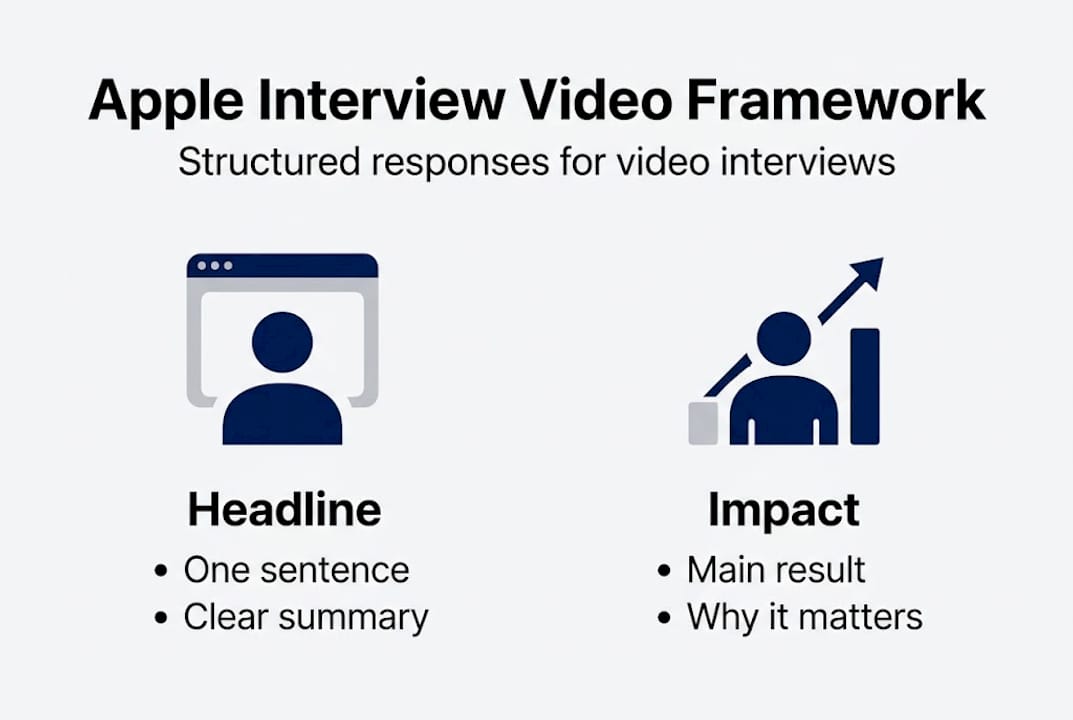
For structuring your answers on video, use a headline-thesis-impact framework. Open with a one-sentence headline that signals your direction. Follow with your core reasoning. Close with the measurable impact or outcome. This structure keeps your answer focused and easy to follow.
Managing nerves on camera is a genuine skill. Slow your breathing before you go live. Speak slightly slower than feels natural. Nodding gently as you listen signals engagement without appearing performative.
As Apple’s process makes clear, candidates are assessed not just on content but on explanation quality, with an expectation to generate your own test cases and clarify trade-offs. That means your communication style is part of your technical score.
Common on-camera mistakes to avoid:
- Looking at your own video feed instead of the camera
- Speaking too quickly when nervous
- Giving long, unstructured answers without signposting
- Failing to pause and check in with the interviewer
Pro Tip: Practise your answers using camera confidence techniques specifically designed for interview settings. Watching your own recordings is uncomfortable at first, but it is the fastest way to identify and fix habits you did not know you had.
Why mastering the Apple interview is less about answers and more about dialogue
Here is a perspective that most preparation guides miss entirely. The conventional wisdom says: prepare more answers, cover more topics, rehearse more stories. But Apple’s interview culture, particularly at senior levels, rewards something different.
Apple treats the interview as a collaborative intellectual exercise. The best candidates are not the ones who arrive with the most polished answers. They are the ones who ask the sharpest clarifying questions, who openly discuss trade-offs, and who treat the interviewer as a thinking partner rather than an audience.
Over-preparing for specific questions can actually work against you. It makes your answers feel scripted and your thinking feel rigid. What Apple wants to see is how you think, not just what you know.
The shift is subtle but powerful. Instead of rehearsing answers, rehearse frameworks. Instead of memorising stories, practise articulating the reasoning behind your decisions. On video, this means leaning into confident interview delivery that feels genuine rather than rehearsed. Authenticity and intellectual curiosity, expressed clearly on camera, are what truly stand out.
Level up your Apple interview preparation
You now have a clear picture of what Apple’s interview process demands and how to meet it with confidence. The next step is putting that knowledge into deliberate practice.
Pavone.ai gives you a private space to practise Apple-style questions on camera and receive immediate, actionable feedback on your delivery, structure, pacing, and clarity. Use the Apple interview question generator to simulate real scenarios, then work through the video interview confidence course to sharpen how you come across on screen. For focused on-camera interview practice, Pavone is available whenever you are, with no setup required. Your next Apple interview deserves your best preparation.
Frequently asked questions
What technical topics are most common in Apple coding interviews?
Apple interviews frequently cover concurrency, memory and performance optimisation, edge case handling, and designing data structures like LRU caches or thread-safe priority queues. Coding rounds emphasise clean code structure, test case generation, and clear verbal explanation throughout.
How are senior candidates assessed differently during Apple’s behavioural rounds?
Senior candidates are evaluated on cross-organisational influence, ambiguity handling, mentoring styles, and their ability to explain deep project choices. Behavioural rounds for seniors probe project deep-dives, consistency model decisions, and how you lead without direct authority.
What makes Apple’s video interviews unique?
Apple’s process places a premium on clear explanation, thoughtful trade-off analysis, and generating your own test cases during video responses. Explanation quality is scored alongside technical correctness, making communication a core part of your performance.
How can I practise for Apple’s system design questions?
Use frameworks that emphasise Apple’s priorities: privacy, cross-device synchronisation, and resilience under massive scale. System design at Apple rewards candidates who walk through requirements, articulate trade-offs clearly, and address edge cases before being prompted.
Recommended
Ready to practice?
Start improving your speaking skills with AI-powered feedback and analysis.
Try Pavone Free